How long does perimenopause last? What SWAN found
"It'll pass" is not a plan. The SWAN study followed thousands of women for decades and put numbers on how long the transition, and its symptoms, really last.
- Oestrogen
- Progesterone
Key takeaways
- SWAN (the Study of Women's Health Across the Nation) has followed more than 3,000 women through the menopause transition since 1996.
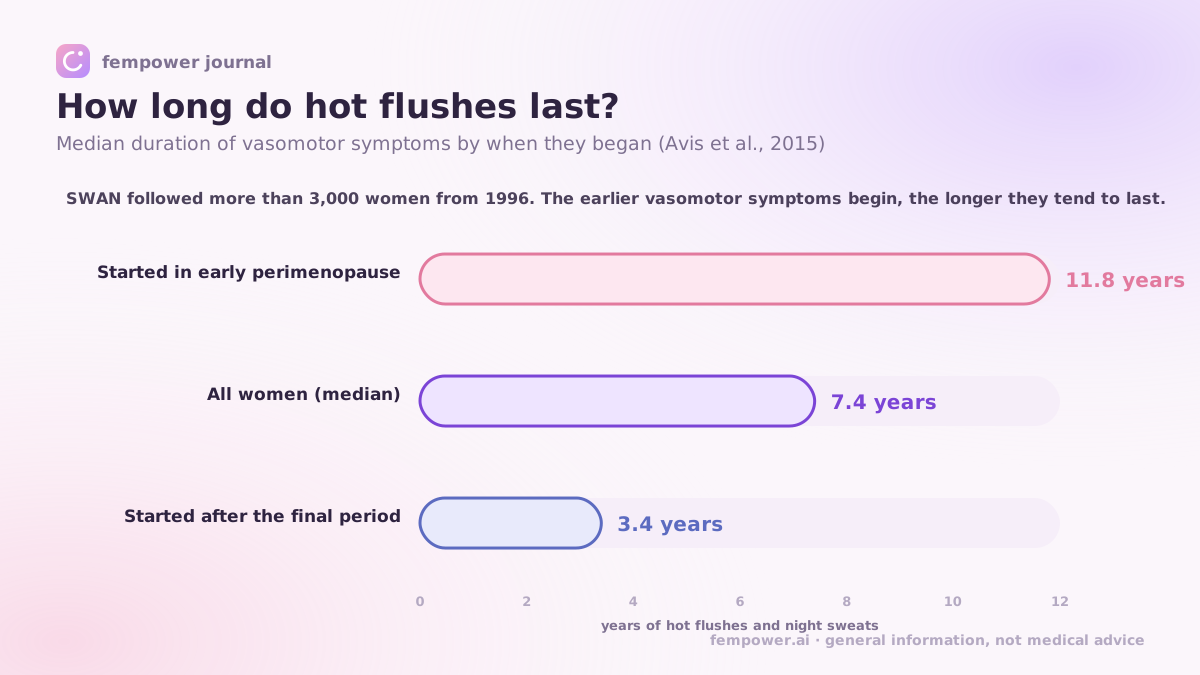
- The median duration of hot flushes and night sweats was 7.4 years. When they began in early perimenopause, the median was more than 11 years.
- The transition itself, from the first cycle changes to the last period, typically takes four to eight years.
- Duration and symptom profile vary by ethnicity, and by things like smoking, earlier onset and depressive symptoms.
- The practical conclusion is to plan in years. Waiting it out assumes a timeline the data does not support.
One of the most common questions in perimenopause is also one of the hardest for a GP to answer honestly in ten minutes: how long is this going to go on? For a long time the folk answer was "a couple of years". Then a large American study followed women for long enough to check, and the answer was quite different.
What SWAN is
The Study of Women's Health Across the Nation, usually just called SWAN, began in 1996 across seven sites in the United States. It enrolled more than 3,000 women aged 42 to 52 who had not yet reached menopause, deliberately recruiting Black, White, Chinese, Japanese and Hispanic participants so that the findings would not describe one group only. It has followed them ever since, with regular visits recording cycles, symptoms, hormones, sleep, mood, bone, heart and much else.
Because it started before menopause and kept going long after, SWAN can answer questions that one-off surveys cannot. Chief among them: when do symptoms start relative to the last period, and how long do they last?
The 7.4 years
In 2015, Nancy Avis and colleagues published the duration analysis in JAMA Internal Medicine. They looked at the roughly 1,400 SWAN participants who reported frequent hot flushes or night sweats, and followed them for a median of 13 years.
- The median total duration of frequent vasomotor symptoms was 7.4 years.
- Women whose symptoms started in early perimenopause, while cycles were still fairly regular, had the longest course: a median of more than 11.8 years.
- Women whose symptoms did not start until after their last period had the shortest: a median of about 3.4 years.
- After the final period, symptoms continued for a median of 4.5 years.
The pattern is counter-intuitive and important. Starting early means a longer run. If you are 42 with new night sweats, the data suggests you are near the beginning of something that lasts around a decade.
The transition itself
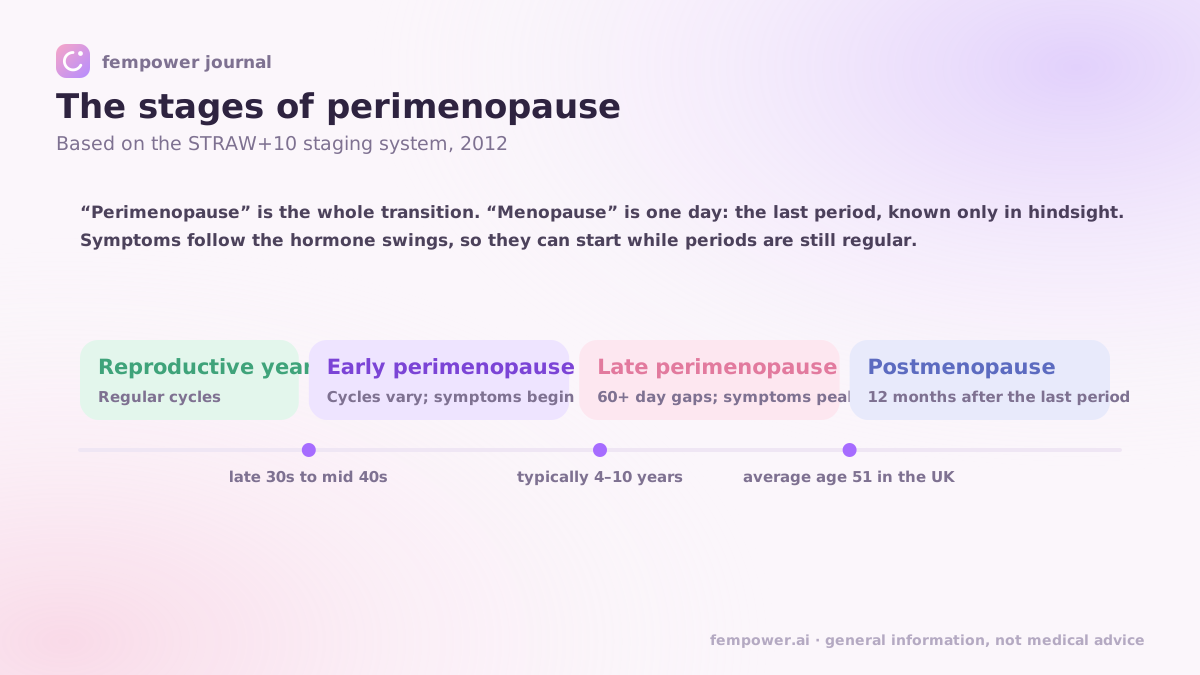
Hot flushes are one symptom. The transition, defined in the STRAW+10 staging system as the period from the first persistent change in cycle length to a year after the last period, typically takes four to eight years. Early perimenopause, when cycles vary by a week or more, can last several years on its own. Late perimenopause, with gaps of sixty days or longer, usually lasts one to three years. Symptoms like broken sleep, anxiety and brain fog often begin in the early stage, well before hot flushes, and well before anyone uses the word menopause. Read what perimenopause is for the full staging.
Who has a longer course
SWAN also found that duration varies a great deal between women. Several things were associated with a longer run of symptoms:
- Earlier onset, as above. The strongest predictor.
- Ethnicity. Black participants reported the longest median duration of vasomotor symptoms, around ten years, and Japanese and Chinese participants the shortest. The symptom mix varied too: some groups reported more joint pain or sleep disturbance and fewer flushes.
- Smoking.
- Depressive symptoms and anxiety at the start of the transition.
- Higher perceived stress and lower education, which probably reflect circumstances more than biology.
None of these are destiny; they are averages from a large group. They do mean that "it lasts a couple of years" is wrong for most women and very wrong for some.
What to do with a decade
Knowing the timeline is there to change the strategy. If something lasts seven years, then a plan that involves tolerating it is a plan to lose seven years. The alternatives:
- Treat symptoms that are affecting your life now. HRT, CBT and the newer non-hormonal drugs all exist because the wait is long.
- Track, so you know which of your symptoms are hormonal and which are something else. Seven years is long enough for other things to happen too.
- Plan for the phases. Early perimenopause and late perimenopause feel different, and the things that help change.
- Tell people. A partner or manager who thinks this is a few months of hot flushes will not understand year four.
Questions people ask
- How long does perimenopause last?
- The transition from the first cycle changes to a year after the last period typically takes four to eight years. In the SWAN study, hot flushes and night sweats lasted a median of 7.4 years, and more than 11 years when they began in early perimenopause.
- What is the SWAN study?
- The Study of Women's Health Across the Nation is a long-running US study that has followed more than 3,000 women of several ethnicities through the menopause transition since 1996, recording symptoms, hormones and health outcomes.
- Do hot flushes last longer if they start early?
- Yes. In SWAN, women whose hot flushes started in early perimenopause had the longest course, a median of over 11 years, while those whose flushes started after their last period had a median of about 3.4 years.
- Does perimenopause last longer for some women?
- Duration varied by ethnicity in SWAN, with Black participants reporting the longest median duration of vasomotor symptoms. Smoking, earlier onset and depressive symptoms at the start were also linked to a longer course.
References
- Duration of menopausal vasomotor symptoms over the menopause transition. JAMA Internal Medicine (Avis NE, Crawford SL, Greendale G, et al., for the SWAN study), 2015.
- Executive summary of the Stages of Reproductive Aging Workshop + 10: addressing the unfinished agenda of staging reproductive aging. Menopause (Harlow SD, Gass M, Hall JE, et al.), 2012.
- Menopause: identification and management (NG23). NICE, 2024.
- Study of Women's Health Across the Nation (SWAN): study overview. SWAN Study, 2024.