CBT for menopause symptoms: why NICE recommends it
CBT sounds like an odd hot flush treatment. Two UK trials and the 2024 NICE guideline say it works. What it involves, and what it can and cannot do.
- Oestrogen
- Cortisol
Key takeaways
- Menopause-specific CBT reduces how much hot flushes and night sweats bother you, and improves sleep and mood. It does not reduce how many flushes you have by much.
- Two UK randomised trials, MENOS 1 and MENOS 2, showed the benefit held at six months, including in women who could not take HRT.
- The 2024 update to NICE guideline NG23 recommends CBT for vasomotor symptoms, sleep problems and low mood, alongside or instead of HRT.
- It involves paced breathing, catching the catastrophic thought during a flush, and behavioural sleep rules. Four to six sessions, or a self-help book.
- It works whether or not you take HRT, and if you need oestrogen it does not replace it.
If a GP suggests cognitive behavioural therapy for your hot flushes, it can land badly. It can sound like being told it is in your head. The flush is a real, physical event driven by oestrogen swings and the brain's thermostat. What CBT changes is everything that happens in the seconds and hours after the flush starts, and that turns out to be a large part of how bad the whole thing is.
What the MENOS trials found
Two randomised trials from King's College London, led by Professor Myra Hunter, are the reason CBT is in the guideline. MENOS 1 (2012) recruited women who had hot flushes after breast cancer treatment, a group who mostly cannot use HRT. MENOS 2 (2012) recruited women going through menopause in the ordinary way. Both compared group CBT with usual care.
- The "problem rating" for hot flushes and night sweats, meaning how much they interfered with life, fell substantially in the CBT groups and stayed down at six months.
- Sleep, mood and quality of life improved.
- The frequency of flushes changed much less. Women were having roughly as many, but they were getting in the way roughly half as much.
- A later trial showed a self-help version, working through a book with brief guidance, produced similar results.
That last point matters. Much of it can be done from a paperback in four weeks, with no waiting list.
What NICE says
NICE guideline NG23 on menopause was updated in November 2024. It now recommends that CBT be offered for vasomotor symptoms, for sleep problems related to menopause, and for low mood or anxiety in the transition. It can be offered on its own, or alongside HRT, or when HRT is not wanted or not suitable. The guideline treats it as an option in its own right.
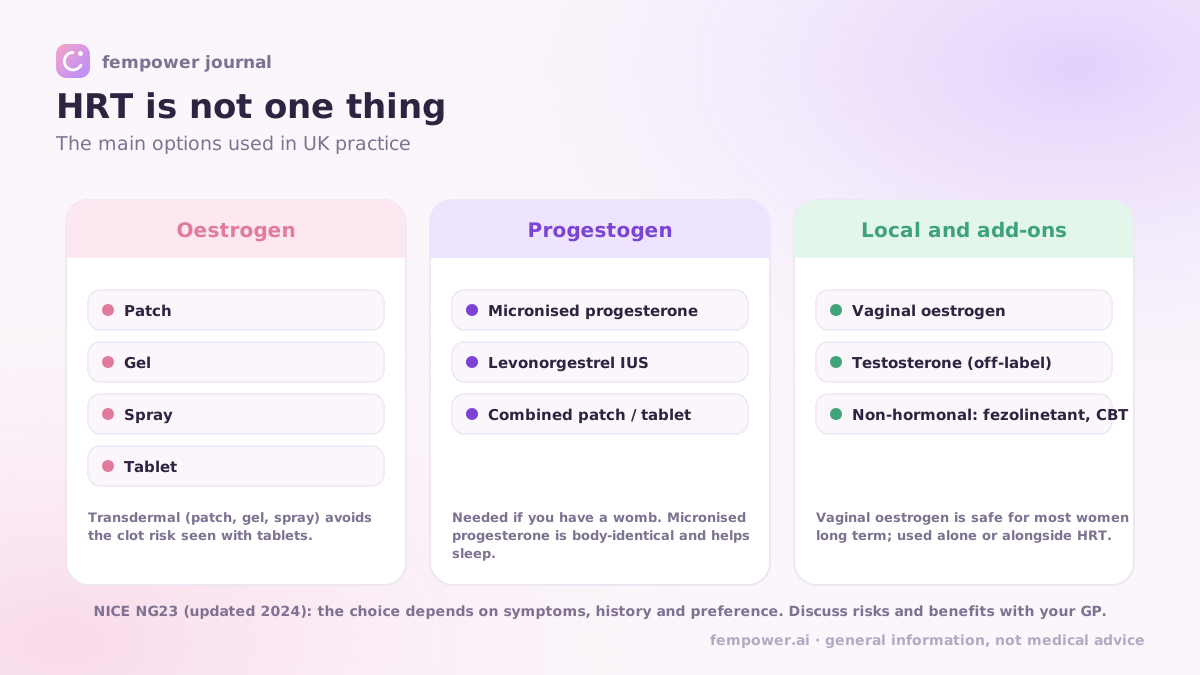
NICE does not say CBT instead of HRT for everyone. If you have low oestrogen symptoms, brain fog, joint pain, vaginal dryness, CBT does not replace oestrogen. Read what the evidence says about HRT now alongside this.
What menopause CBT involves
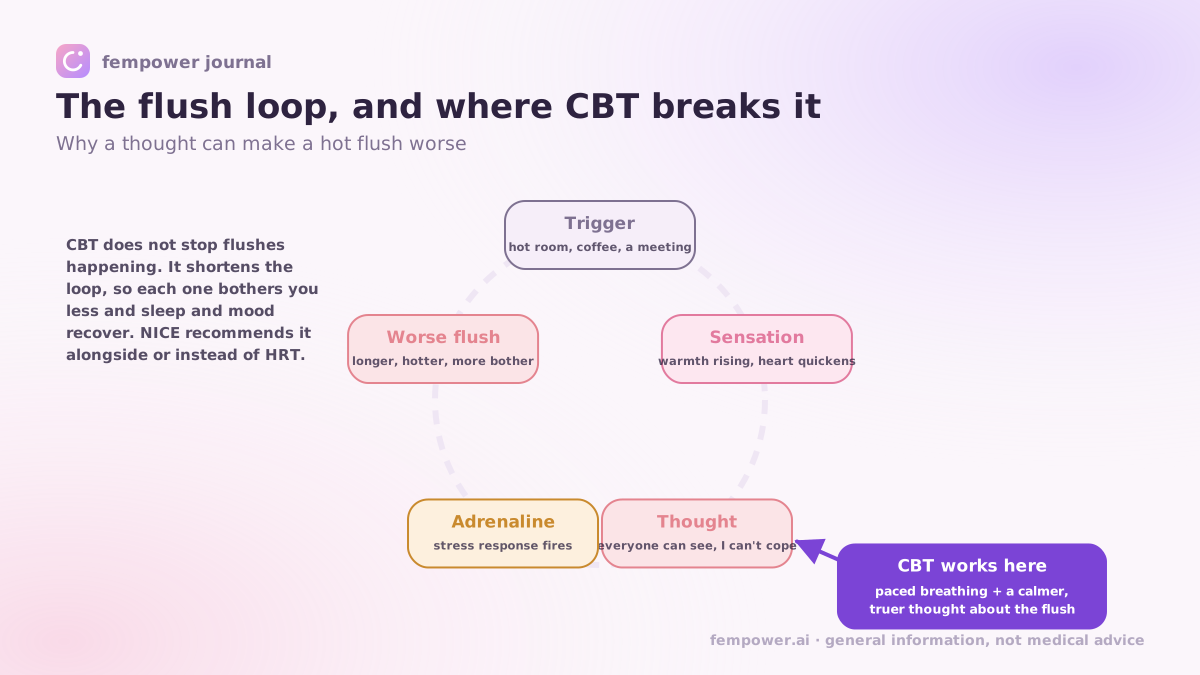
It is a short, structured programme, quite different from general talking therapy, built around one loop, shown in the diagram above.
- A trigger. A warm room, coffee, a stressful email, or nothing at all.
- The sensation. Heat rising, heart rate up, sweat starting.
- The thought. "Everyone can see. I can't cope with this. It's going to ruin the meeting."
- The response. Adrenaline. Which raises heart rate and skin temperature, which makes the flush worse and last longer.
CBT works on step three, through:
- Paced breathing. Slow, diaphragmatic breathing at the first sign of a flush, six or so breaths a minute, to blunt the adrenaline response.
- Catching and reframing the thought. "This will pass in three minutes, it always does. Most people do not notice, and those who do, do not care." Practised until it is automatic.
- Reducing avoidance. Keeping the meeting, staying in your own bed, so the flush stops being something that controls your life.
- Sleep rules. Fixed wake time, no clock-watching, out of bed if awake more than twenty minutes, cool bedroom. Standard CBT for insomnia, applied to night sweats.
- Stress and pacing. Because cortisol and adrenaline feed the loop, and the stress axis is less buffered in perimenopause.
How to get it
- Self-help. Managing Hot Flushes and Night Sweats by Myra Hunter and Melanie Smith is the four-week programme used in the trials, in book form.
- NHS Talking Therapies. You can self-refer in England. Ask specifically for menopause-focused CBT, or CBT for insomnia if sleep is the main problem.
- Group programmes. Some menopause clinics and workplaces run the six-session group version.
- Digital versions. Several apps and online courses now deliver menopause CBT. Look for ones that name the MENOS programme or its authors.
The honest limits
CBT reduces the impact of flushes more than their number. If you are having twenty a day, you may still be having fifteen afterwards. It asks for practice, and the effect depends on doing the breathing and the reframing in the moment, which takes practice. It leaves the things low oestrogen does to your body untouched. It is one tool, and for a lot of women it is the tool that makes everything else manageable.
Questions people ask
- Does CBT work for hot flushes?
- Yes, for how much they bother you. Two UK randomised trials found menopause-specific CBT roughly halved the problem rating of hot flushes and night sweats at six months, and improved sleep and mood. It has less effect on the number of flushes.
- Why does NICE recommend CBT for menopause?
- The 2024 update to NICE guideline NG23 recommends CBT for vasomotor symptoms, sleep problems and low mood because randomised trials show it works, it has no hormonal side effects, and it can be used whether or not someone takes HRT.
- Is CBT a replacement for HRT?
- No. CBT helps with the impact of flushes, sleep and mood. It does not replace oestrogen for symptoms caused by low oestrogen. NICE presents them as options that can be used together or separately.
- Can I do menopause CBT myself?
- Yes. The self-help version of the MENOS programme, in the book Managing Hot Flushes and Night Sweats by Hunter and Smith, produced similar results to the group version in a trial. NHS Talking Therapies also offers CBT by self-referral in England.
References
- Menopause: identification and management (NG23). NICE, 2024.
- Effectiveness of group and self-help cognitive behaviour therapy in reducing problematic menopausal hot flushes and night sweats (MENOS 2): a randomized controlled trial. Menopause (Ayers B, Smith M, Hellier J, Mann E, Hunter MS), 2012.
- Cognitive behavioural treatment for women who have menopausal symptoms after breast cancer treatment (MENOS 1): a randomised controlled trial. The Lancet Oncology (Mann E, Smith MJ, Hellier J, et al.), 2012.
- Managing Hot Flushes and Night Sweats: A Cognitive Behavioural Self-help Guide to the Menopause. Routledge (Hunter MS, Smith M), 2014.
- Cognitive behaviour therapy (CBT) for menopausal symptoms: fact sheet. British Menopause Society, 2023.