HRT in 2026: what the evidence says
Twenty years of headlines have left most women confused about HRT. This is a plain summary of what the studies found, what changed on reanalysis, and how UK prescribing looks now.
- Oestrogen
- Progesterone
- Testosterone
Key takeaways
- The 2002 WHI headlines came from a study of women averaging 63 years old on older tablet forms. Reanalysis showed age and timing matter enormously.
- Long-term follow-up published in 2017 found no increase in overall mortality among women who had taken HRT.
- The breast cancer risk from combined HRT is real but small in absolute terms, comparable to the risk from moderate drinking or being overweight.
- Transdermal oestradiol with micronised progesterone is the usual UK choice, and does not carry the clot risk of tablets.
- NICE updated its guidance in November 2024. HRT remains the most effective treatment for symptoms and it protects bone.
Ask ten women what they think about HRT and you will get ten answers, most of them shaped by a newspaper front page from 2002. The science has moved a long way since. This post walks through what happened, what the reanalyses showed, and how prescribing in the UK looks now, so that you can have the conversation with your GP from a position of knowing the numbers.
What went wrong in 2002
The Women's Health Initiative (WHI) was a large American trial designed to test whether HRT prevented heart disease. In July 2002 its combined oestrogen-plus-progestin arm was stopped early and the results announced at a press conference before most doctors had seen the paper. The headlines said HRT caused breast cancer, heart attacks and strokes. Prescriptions collapsed worldwide within months.
Three things about that trial matter. The average participant was 63, more than a decade past menopause. The oestrogen was an oral conjugated equine product and the progestogen a synthetic one, both of which behave differently from what is prescribed today. And the absolute increases were small, translating to a handful of extra events per ten thousand women per year, which the headlines did not convey.
What reanalysis found
Over the following fifteen years the WHI data was sliced by age. Women who started HRT under 60, or within ten years of menopause, did not show the cardiovascular harm seen in older starters, and some analyses suggested benefit. This became known as the timing hypothesis: oestrogen given to relatively healthy arteries behaves differently from oestrogen given to arteries that have already aged without it.
In 2017 the WHI investigators published eighteen years of follow-up in JAMA. Across both arms, women who had taken HRT had no increase in all-cause mortality compared with placebo, and no increase in deaths from cardiovascular disease or cancer overall. Given that the whole scare was about HRT killing people, this was the quiet correction the original press conference never got.
Breast cancer, in numbers
The risk that worries people most deserves the most careful treatment. In 2019 the Collaborative Group on Hormonal Factors in Breast Cancer published a meta-analysis in The Lancet of over 100,000 women with breast cancer. It confirmed that combined oestrogen and progestogen HRT increases risk, that the risk rises with duration, and that oestrogen-only HRT carries a much smaller increase.
In absolute terms, for women starting HRT at 50 and taking it for five years, the Lancet analysis translates to roughly one extra breast cancer for every 50 users of combined HRT, and roughly one in 200 for oestrogen-only. For context, drinking two or more units of alcohol a day, or being overweight after menopause, carries a similar or larger increase. The risk is real, and it sits in the same category as other choices most people make without a second thought.
There is also evidence from French cohort data that micronised progesterone, the body-identical form now standard in the UK, is associated with a smaller increase than the synthetic progestogens used in older studies, though this has not been proven in a randomised trial.
What UK prescribing looks like now
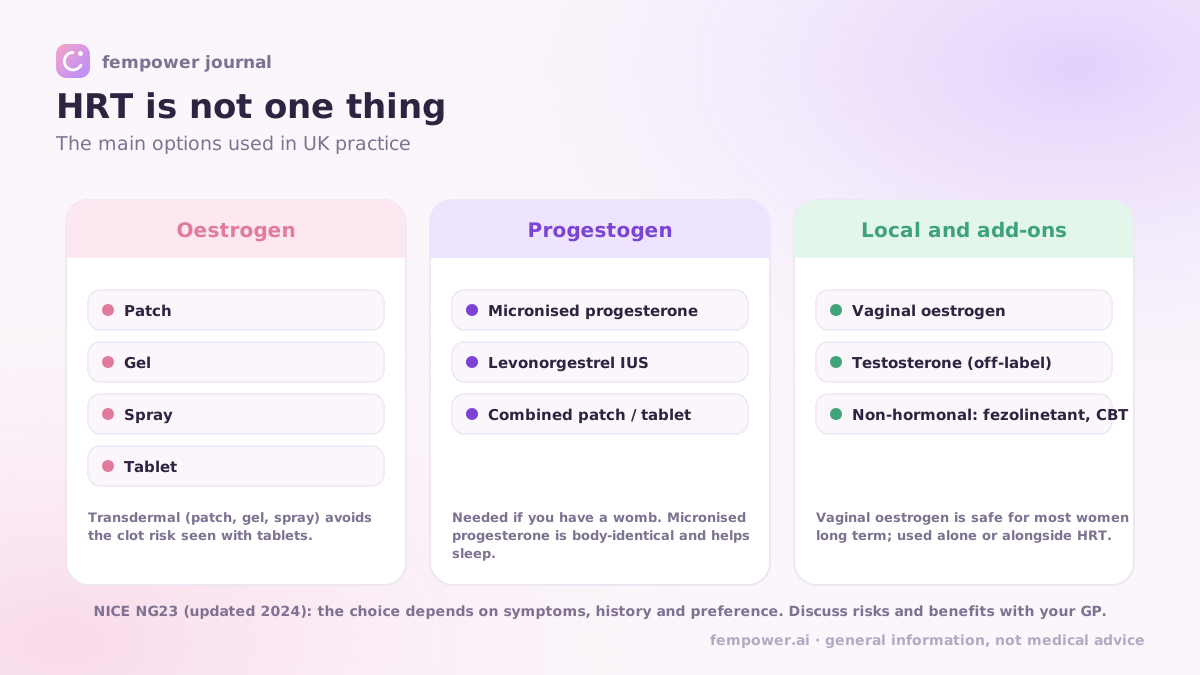
The diagram above shows the pieces. The typical starting regimen in the UK today is:
- Transdermal oestradiol, as a patch, gel or spray. Through the skin, oestradiol does not raise clot risk the way oral tablets do, which is why NICE recommends it for women with any clot risk factors.
- Micronised progesterone, a capsule taken at night, for any woman who still has a womb, to protect the lining. The hormonal coil (levonorgestrel IUS) is an alternative that also gives contraception.
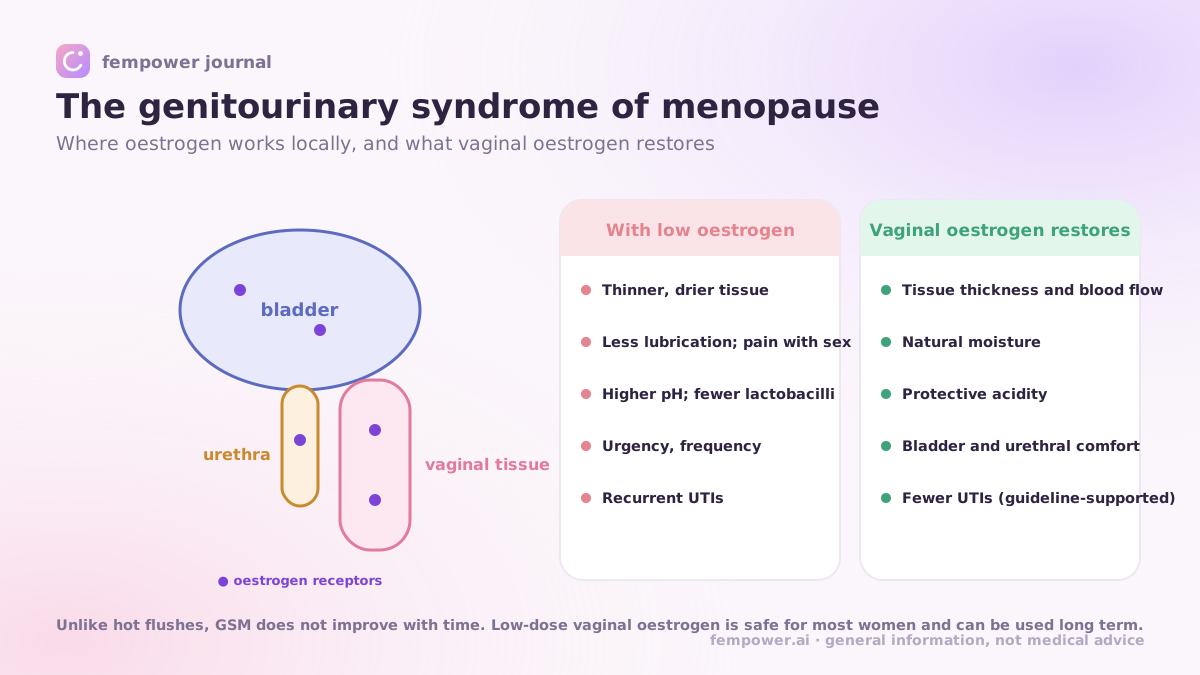
- Vaginal oestrogen, a separate low-dose local treatment for dryness, urinary symptoms and recurrent UTIs. It can be used alone or alongside HRT, long term, and is considered safe for most women.
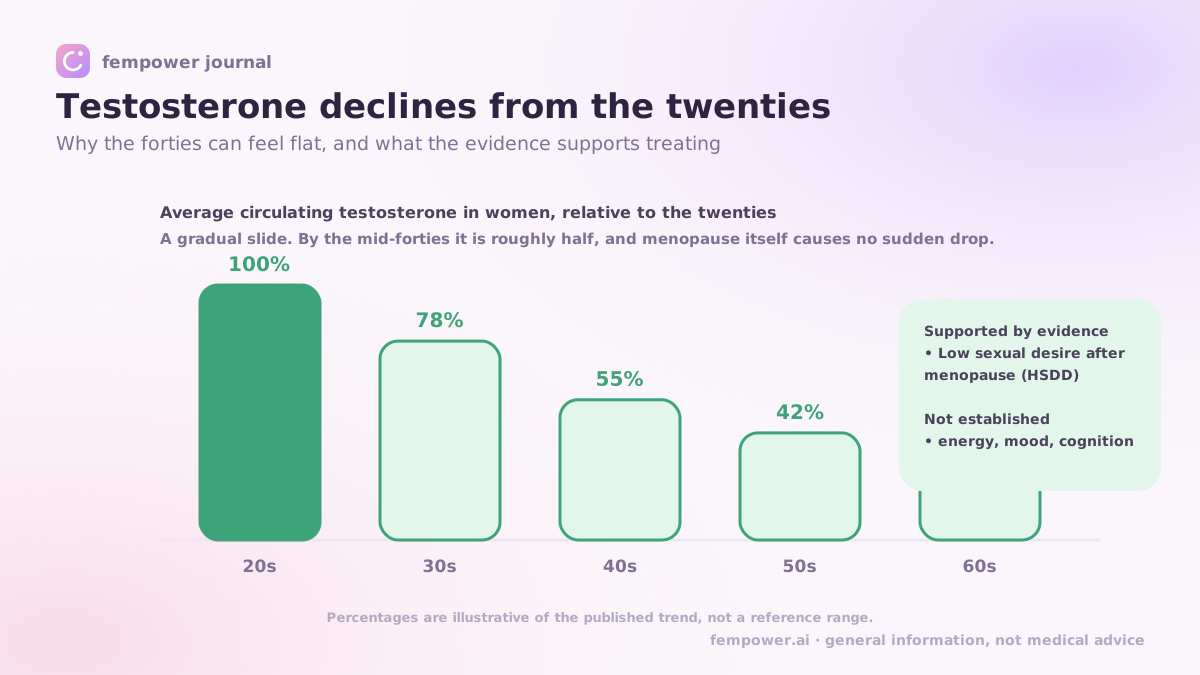
- Testosterone, added for persistent low desire once oestrogen is sorted.
NICE updated NG23 in November 2024. It confirms HRT as the most effective treatment for vasomotor symptoms, supports it for mood symptoms linked to menopause, recommends that benefits and risks are discussed with each woman individually, with no blanket rules, and adds cognitive behavioural therapy as an option alongside or instead of HRT. Perimenopausal women can start HRT before their periods stop, using a cyclical regimen.
Who should not take it
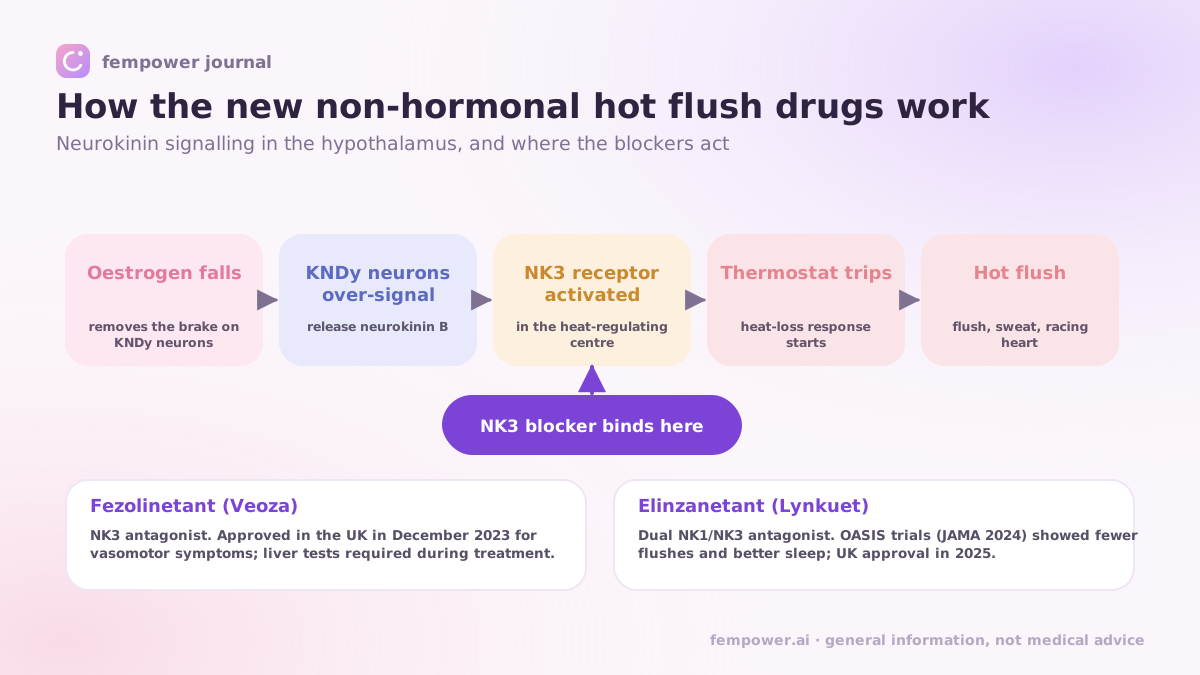
Systemic HRT is generally not prescribed for women with a current or previous hormone-sensitive breast cancer, undiagnosed vaginal bleeding, an active clot, or certain liver conditions. Migraine with aura and a history of clots usually steer prescribing towards transdermal forms without ruling HRT out. Every one of these is a conversation to have with your clinician, and the new non-hormonal drugs now give women who cannot take HRT a real alternative for flushes.
Questions people ask
- Is HRT safe?
- For most women starting under 60 or within ten years of menopause, the benefits outweigh the risks. Eighteen-year follow-up of the WHI trial found no increase in overall mortality. Risks are individual and should be discussed with a clinician.
- Does HRT cause breast cancer?
- Combined oestrogen and progestogen HRT is associated with a small increase in breast cancer risk that rises with duration: roughly one extra case per 50 users over five years from age 50, according to the 2019 Lancet meta-analysis. Oestrogen-only HRT carries a much smaller increase. The risk is similar in scale to that from moderate alcohol intake or being overweight.
- What type of HRT is usually prescribed in the UK?
- Transdermal oestradiol (patch, gel or spray) with micronised progesterone for women who have a womb. Transdermal oestrogen does not increase clot risk the way oral tablets do. Vaginal oestrogen and testosterone can be added separately.
- Can I start HRT in perimenopause, before my periods stop?
- Yes. NICE guidance supports starting HRT in perimenopause using a cyclical regimen. You do not have to wait until your periods have stopped.
References
- Risks and benefits of estrogen plus progestin in healthy postmenopausal women: principal results from the Women's Health Initiative randomized controlled trial. JAMA (Rossouw JE et al.), 2002.
- Menopausal Hormone Therapy and Long-term All-Cause and Cause-Specific Mortality: The Women's Health Initiative Randomized Trials. JAMA (Manson JE et al.), 2017.
- Type and timing of menopausal hormone therapy and breast cancer risk: individual participant meta-analysis of the worldwide epidemiological evidence. The Lancet (Collaborative Group on Hormonal Factors in Breast Cancer), 2019.
- Use of hormone replacement therapy and risk of venous thromboembolism: nested case-control studies using the QResearch and CPRD databases. BMJ (Vinogradova Y et al.), 2019.
- Menopause: identification and management (NG23). NICE, 2024.