Vaginal dryness, UTIs and the genitourinary syndrome of menopause
It is the symptom cluster nobody mentions to their GP, and it does not improve with time. It is also one of the most treatable parts of the whole transition.
- Oestrogen
Key takeaways
- Genitourinary syndrome of menopause (GSM) is the name, since 2014, for dryness, soreness, pain with sex, urinary urgency and recurrent UTIs caused by low oestrogen in the tissue.
- It affects roughly half of postmenopausal women and, unlike hot flushes, does not improve with time. It tends to get worse.
- Low-dose vaginal oestrogen is safe for most women, is not the same as systemic HRT, can be used long term, and reduces recurrent UTIs. NICE and the British Menopause Society both recommend it.
- Moisturisers, lubricants and pelvic floor work help too, and are different things from each other.
- Most women never raise it with a GP. A single sentence is enough to start.
There is a symptom cluster that affects around half of women after menopause, often starts in perimenopause, slowly gets worse, and is one of the most treatable things in the whole transition. It is also the one people are least likely to mention. This post is about naming it, explaining it, and giving you the sentence to say.
What GSM is
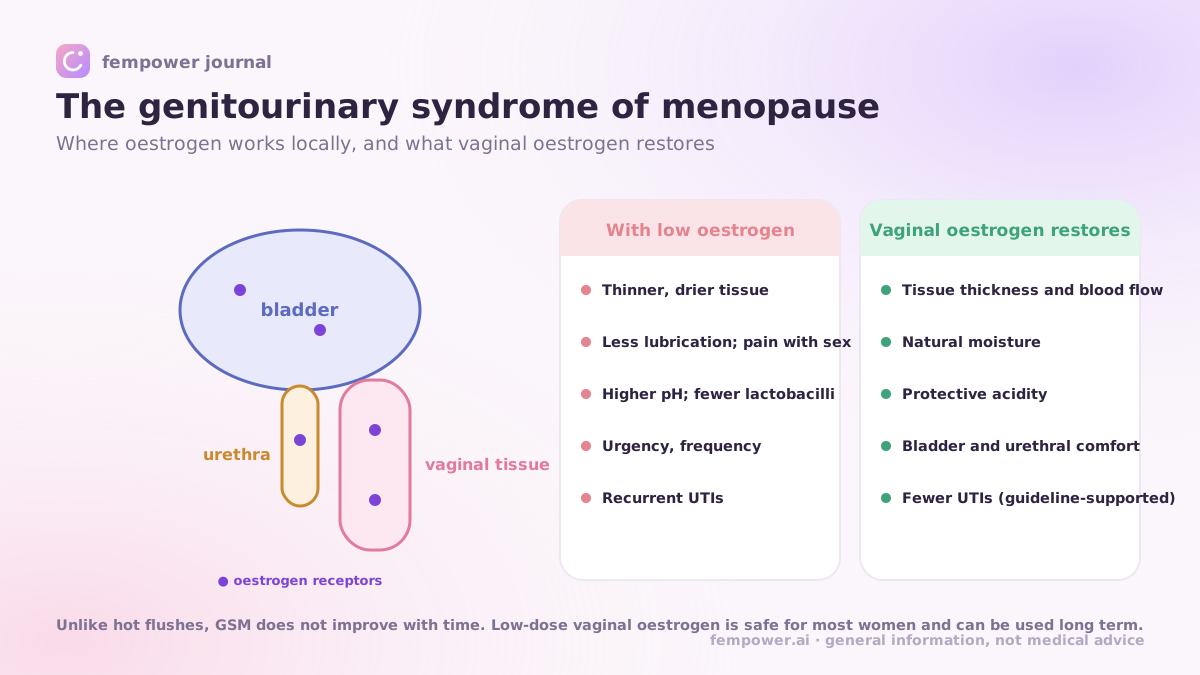
In 2014 two professional societies agreed on a new term: genitourinary syndrome of menopause, or GSM. It replaced older phrases like "vaginal atrophy", which described one tissue and sounded like a verdict. GSM covers the whole set of changes low oestrogen causes in the lower urinary and genital tract:
- Vaginal dryness, itching, burning or soreness.
- Pain or bleeding with sex, and a loss of natural lubrication.
- Urinary urgency and frequency, and getting up at night to pass urine.
- Recurrent urinary tract infections.
- Discomfort on wiping, with tight clothes, or on a bike.
You do not need all of them. Recurrent UTIs on their own, in a woman in her late forties or fifties, are often GSM even with no dryness she has noticed.
Why oestrogen matters here
The vagina, the urethra and the base of the bladder all developed from the same embryonic tissue, and all of them are packed with oestrogen receptors. When oestrogen is present, the vaginal lining is thick and elastic, it produces glycogen, the friendly lactobacilli that feed on that glycogen keep the pH acidic, and the acidic environment keeps infection-causing bacteria out. The urethra is cushioned and the bladder lining is calm.
As oestrogen falls and stays low, the lining thins, the glycogen goes, the lactobacilli decline, pH rises, and the bacteria that cause UTIs move in. The urethra thins too, and the bladder becomes more irritable. Every symptom on the list above comes from that one change. That is why GSM is different from hot flushes: flushes are the brain adjusting to a swing, and the brain eventually adjusts. GSM is tissue without the hormone it depends on, and it stays that way unless the hormone is put back.
Vaginal oestrogen: what it is
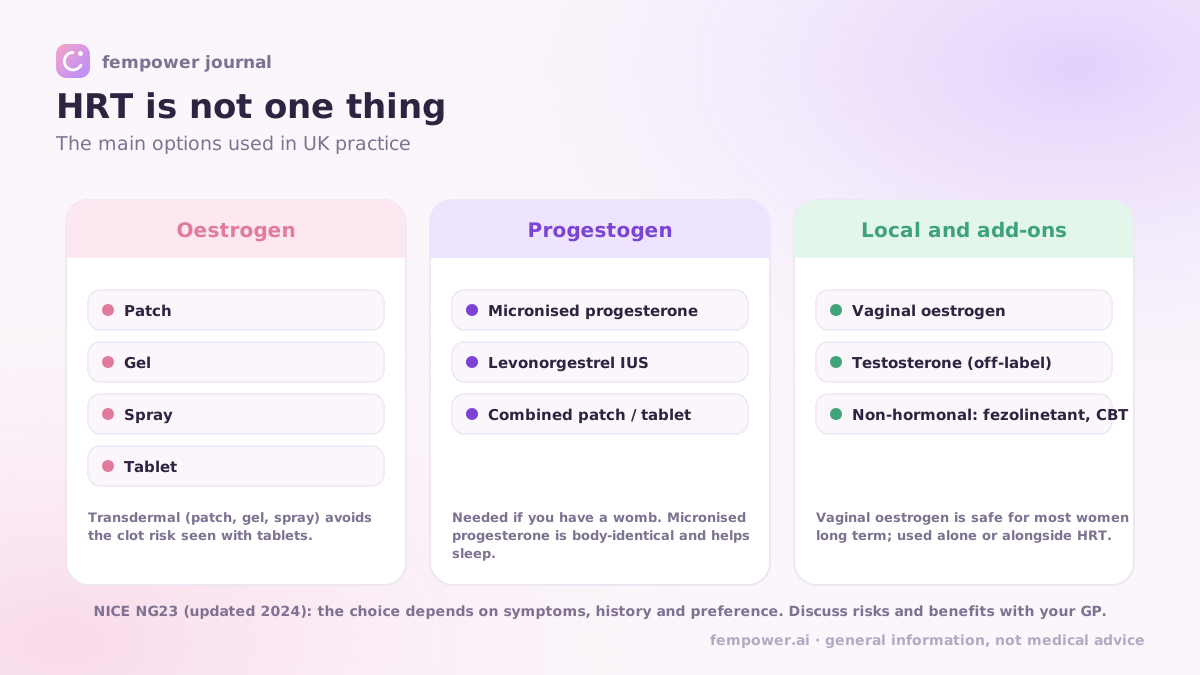
Vaginal oestrogen means a very low dose of oestrogen applied directly where it is needed: a pessary, a cream, a gel or a ring. It restores the tissue locally. Very little enters the bloodstream. It is not the same as systemic HRT, it does not need a progestogen alongside it, and it can be used by many women who cannot or do not want to take HRT.
- NICE guideline NG23 recommends vaginal oestrogen for GSM, including alongside systemic HRT if needed, and says it can be continued for as long as it is needed.
- The British Menopause Society says it is safe for long-term use and that there is no need for routine monitoring of the womb lining.
- It reduces recurrent UTIs, which is why guidelines on UTI in postmenopausal women recommend considering it before long-term antibiotics.
- After breast cancer, many women can still use it, following a conversation with their oncology team. NICE specifically says it can be considered.
- It takes a few weeks to work, and symptoms return if it is stopped. It is a maintenance treatment, like moisturiser for skin.
One vaginal oestrogen pessary is now available over the counter from a pharmacist in the UK, for women over 50, without a prescription.
The other things that help
- Vaginal moisturisers are used regularly, two or three times a week, whether or not you are having sex. They rehydrate tissue. Look for ones with a pH around 4 and no glycerin or perfume.
- Lubricants are used at the time of sex. Water-based or silicone-based; avoid oil-based with condoms. They reduce friction in the moment and leave the tissue as it is.
- Pelvic floor physiotherapy helps with urgency, with pain from muscles that have tightened in response to soreness, and with prolapse. Ask for a referral.
- Not using perfumed washes, wipes or bubble bath, which strip what protection remains.
Why nobody says it, and how to
Surveys consistently find that most women with GSM have never discussed it with a clinician. Embarrassment is part of it. So is the assumption that it is normal ageing to be endured. So is the fact that appointments are short and hot flushes get the airtime. And UTIs get treated as UTIs, one antibiotic course at a time, without anyone asking why they keep coming.
You do not need to explain the mechanism. One sentence does it:
I think I have genitourinary syndrome of menopause. I have dryness and recurrent UTIs, and I'd like to discuss vaginal oestrogen.
A GP hearing that knows exactly what you mean and what the guideline says. If the answer is no without a reason, ask for the reason, or ask for a referral to a menopause clinic. See the FAQ for more on what to bring to an appointment.
Questions people ask
- What is genitourinary syndrome of menopause?
- GSM is the term, adopted in 2014, for the changes low oestrogen causes in the vagina, urethra and bladder: dryness, soreness, pain with sex, urinary urgency and recurrent UTIs. It affects around half of postmenopausal women and does not improve on its own.
- Is vaginal oestrogen safe?
- For most women, yes. It is a very low dose applied locally, with minimal absorption into the bloodstream. NICE and the British Menopause Society recommend it and say it can be used long term without a progestogen. Many women with a breast cancer history can use it after specialist advice.
- Can low oestrogen cause recurrent UTIs?
- Yes. Low oestrogen thins the vaginal and urethral lining, reduces protective lactobacilli and raises vaginal pH, which lets infection-causing bacteria establish. Vaginal oestrogen reduces recurrent UTIs and is recommended before long-term antibiotics.
- Does vaginal dryness get better after menopause?
- No. Unlike hot flushes, GSM tends to get worse over time because the tissue depends on oestrogen that is no longer there. Treatment with vaginal oestrogen or regular moisturisers is ongoing, and symptoms return if it stops.
- Do I need a prescription for vaginal oestrogen?
- Usually, from a GP. In the UK, one low-dose vaginal oestrogen pessary is also available from a pharmacist without a prescription for women over 50.
References
- Genitourinary syndrome of menopause: new terminology for vulvovaginal atrophy from the International Society for the Study of Women's Sexual Health and the North American Menopause Society. Menopause (Portman DJ, Gass MLS), 2014.
- Menopause: identification and management (NG23). NICE, 2024.
- Urogenital problems: fact sheet. British Menopause Society, 2023.
- Urinary tract infection (recurrent): antimicrobial prescribing (NG112). NICE, 2018.