Testosterone in women: the hormone nobody mentions
Testosterone is the hormone most often left out of the perimenopause conversation. Here is what it does in women, how it declines, and where the evidence for replacing it starts and stops.
- Testosterone
- Oestrogen
Key takeaways
- Women produce testosterone in the ovaries and adrenal glands, and need it.
- Levels fall gradually from the twenties, so the decline is well under way before periods change.
- The strongest evidence for treatment is for low sexual desire after menopause. Evidence for mood, energy and memory is not established.
- In the UK there is no licensed female product, so it is prescribed off-label at a small fraction of the male dose, usually once oestrogen is sorted.
- Blood tests keep treatment within the female range once it has started. They can't tell you whether you need it.
Ask most people to name the hormones of perimenopause and they will say oestrogen, and perhaps progesterone. Testosterone rarely makes the list. Yet women make it, use it in almost every tissue, and lose it steadily across adult life. It is the driver most likely to be left out of the conversation entirely, both at home and in the consulting room.
Yes, women make testosterone
Roughly half of a woman's testosterone comes from the ovaries and half from the adrenal glands, with some more made in other tissues from precursor hormones. Before menopause a woman produces more testosterone than oestrogen by weight. The amounts are small compared with a man, around a tenth, but the receptors are everywhere: muscle, bone, brain, skin and the tissues involved in sexual response.
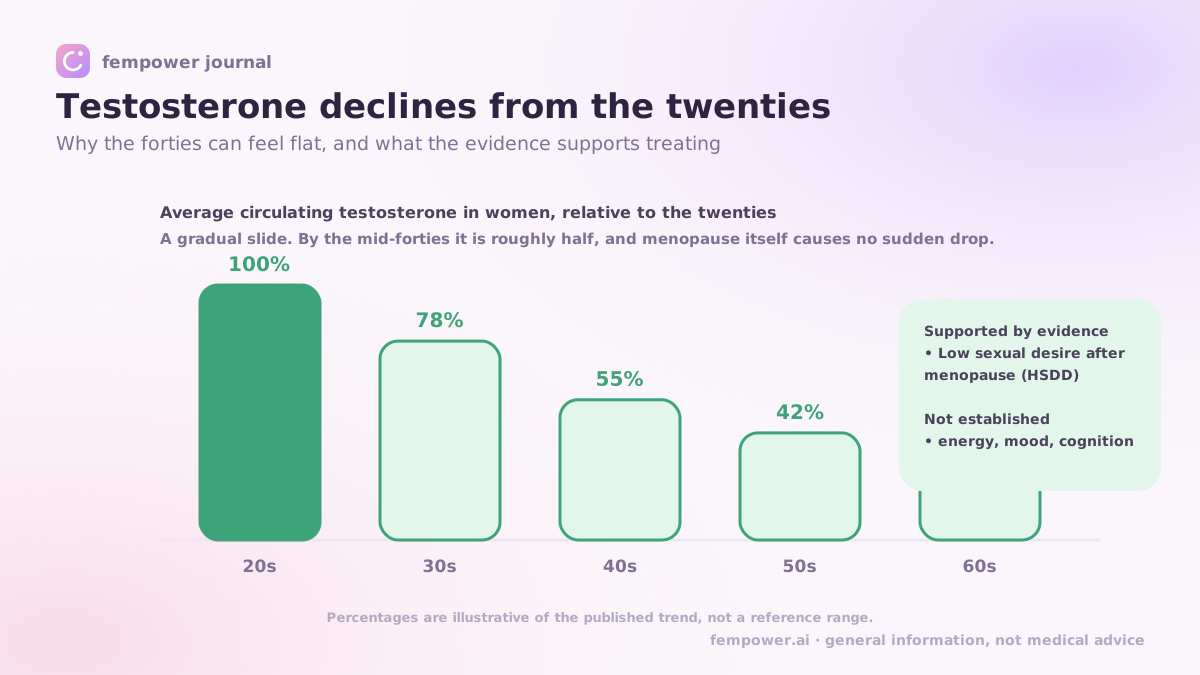
Because it is made partly by the adrenals, testosterone does not switch off at menopause the way ovarian oestrogen and progesterone do. Instead it drifts down with age. That difference matters, and it's why the diagram above is a gentle slope.
The slow decline
Studies of circulating androgens show levels falling from the early twenties onwards. By the mid forties, average testosterone is about half what it was in the twenties. Women who have had both ovaries removed see a much sharper drop, because the ovarian contribution disappears overnight.
This matters for timing. If your testosterone has been sliding for two decades, the effects can arrive before any of the classic perimenopausal changes, and they can be easy to write off as ordinary tiredness, ordinary stress or simply getting older.
What it does, and what it might do
The roles most often described for testosterone in women are:
- Sexual desire and arousal, the area with the clearest evidence.
- Motivation and drive, the wanting-to part of getting things done.
- Muscle and stamina, which is why loss of strength can be a quiet early sign.
- Energy and mental sharpness, though here the evidence is far thinner than the anecdotes.
It is worth being honest about the gap between the first item and the rest. Many women describe feeling flat, unmotivated and mentally foggy, and many describe feeling better on testosterone. Those reports are real. But the controlled trials that would separate a hormone effect from everything else that changes when someone starts to feel heard have not, so far, shown a reliable benefit for mood, energy or cognition.
What the evidence supports
In 2019 an international group of menopause societies published a Global Consensus Position Statement on testosterone in women. Its conclusion was narrow and clear: testosterone therapy, at doses that keep blood levels within the normal range for premenopausal women, is effective for hypoactive sexual desire disorder in postmenopausal women. That is distressing low desire that is not better explained by a relationship problem, depression, medication or another condition.
The same statement found insufficient evidence to recommend testosterone for low mood, tiredness, brain fog, bone or muscle strength. It also made the point that a low blood level on its own is not a diagnosis of anything, because levels vary so much between perfectly well women.
Where it fits with the rest of the picture: testosterone is one of the five drivers in the Fempower hormone model, weighted most heavily against low libido, flat motivation, loss of stamina and mental fatigue. It sits alongside low oestrogen and low progesterone as one explanation among several.
How it is prescribed in the UK
At the time of writing there is no testosterone product licensed for women in the UK. The British Menopause Society provides guidance for clinicians on prescribing male gels off-label at a small fraction of the male dose, typically after oestrogen replacement has been established, because sorting oestrogen first often improves desire on its own. A cream licensed for women in Australia is available in the UK on private prescription.
Blood tests do have a role here, and it's a narrower one than people expect. A baseline level and a follow-up level make sure treatment keeps testosterone within the female range and doesn't creep above it. That is their whole job. Side effects at the right dose are uncommon, but can include extra hair growth or acne at the application site, which is why levels are watched.
Questions people ask
- Do women need testosterone?
- Yes. Women make testosterone in the ovaries and adrenal glands and have receptors for it in muscle, bone, brain and sexual tissue. It supports desire, motivation and muscle strength.
- Does testosterone drop at menopause?
- Not suddenly. It declines gradually from the twenties, so by the forties levels are roughly half what they were. Surgical removal of both ovaries causes a much sharper drop.
- Is testosterone prescribed for women in the UK?
- There is no licensed female product in the UK, but it can be prescribed off-label at a small fraction of the male dose following British Menopause Society guidance, usually once oestrogen replacement is established. The evidence-based indication is distressing low sexual desire after menopause.
- Will a blood test tell me if I need testosterone?
- No. Levels vary widely between healthy women, so a low reading is not a diagnosis. Blood tests are used to keep treatment within the female range once it has started.
References
- Global Consensus Position Statement on the Use of Testosterone Therapy for Women. Journal of Clinical Endocrinology & Metabolism (Davis SR et al.), 2019.
- Circulating androgen levels and self-reported sexual function in women. JAMA (Davis SR et al.), 2005.
- Testosterone replacement in menopause: BMS tool for clinicians. British Menopause Society, 2022.
- Menopause: identification and management (NG23). NICE, 2024.