Progesterone: the first hormone to fall
Long before oestrogen drops, progesterone quietly goes missing. It is the hormone behind a surprising amount of early perimenopause, and the one least often talked about.
- Progesterone
Key takeaways
- Progesterone is made only after ovulation. When cycles stop releasing an egg, the progesterone surge disappears.
- That can start years before oestrogen declines, and while periods still look regular.
- Progesterone is calming. It is converted to allopregnanolone, which works on the same brain receptors as sleep medication.
- Low progesterone is the most likely driver of 3am waking, new anxiety, heavy periods and breast tenderness.
- Body-identical micronised progesterone is the form NICE and the British Menopause Society recommend as part of HRT.
If you have started sleeping badly, feeling anxious for no clear reason, or bleeding more heavily than you used to, and your periods are still arriving on time, the hormone behind it is very likely progesterone, which tends to be the first thing to change in perimenopause.
Where progesterone comes from
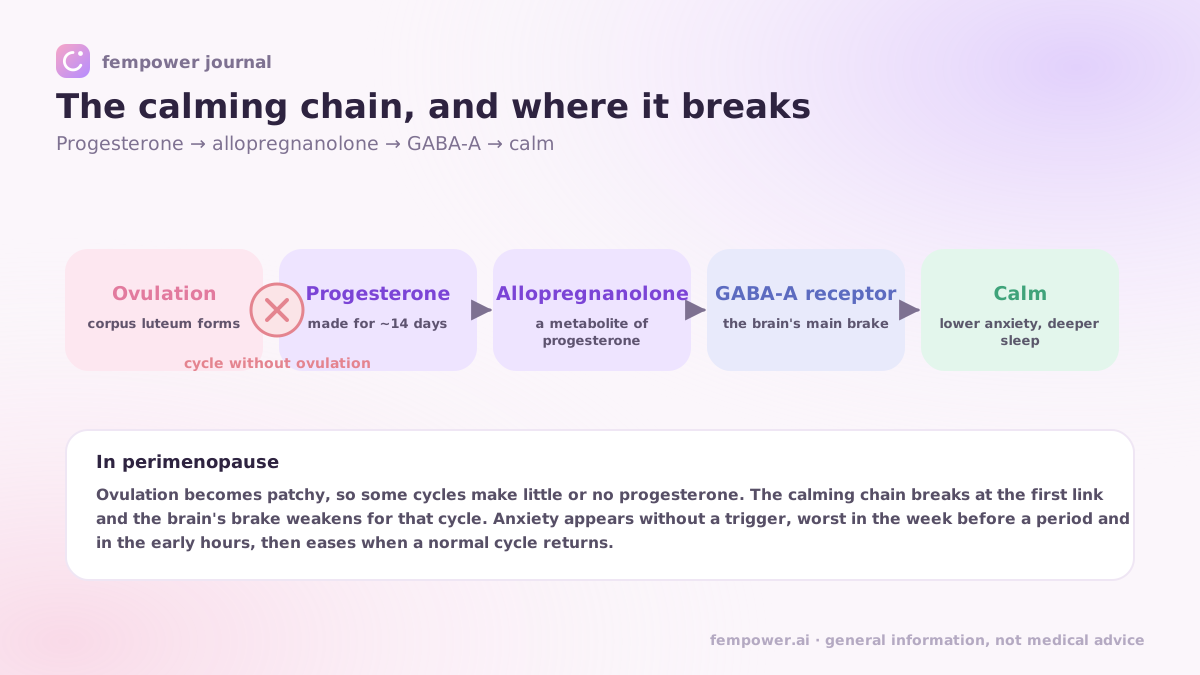
Progesterone has one main source in a menstruating woman: the corpus luteum. That is the small structure left behind in the ovary after an egg is released. For roughly two weeks it produces progesterone, which prepares the womb lining for a possible pregnancy and, if none happens, shuts down, triggering a period.
The consequence is easy to miss: without ovulation there is no corpus luteum, and without a corpus luteum there is no progesterone. You can still have a period without ovulating, because the lining still builds under oestrogen and eventually sheds. But the second half of that cycle has none of the progesterone it should.
Why it falls first
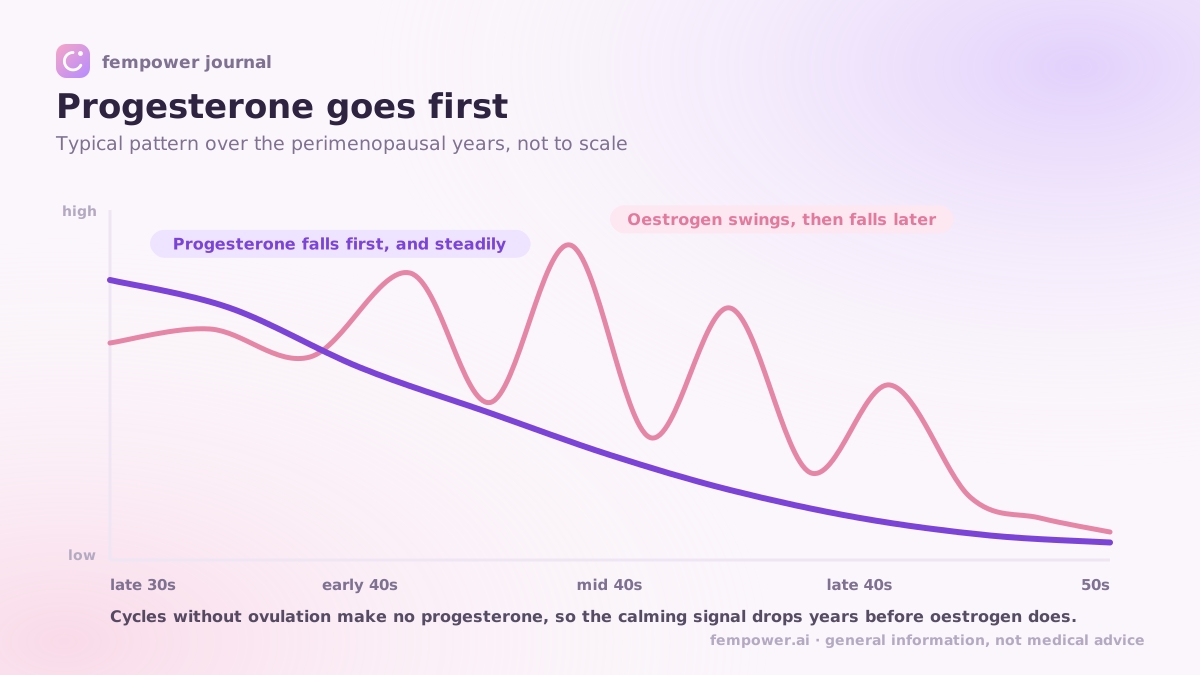
As the ovaries age, more cycles become anovulatory, meaning no egg is released, or the corpus luteum forms but produces less progesterone for a shorter time. This starts happening well before the ovaries run out of the capacity to produce oestrogen. The Canadian endocrinologist Jerilynn Prior has argued for decades, with data to support it, that perimenopause is best described as high, erratic oestrogen alongside low progesterone.
That reframing matters because it explains why so many early symptoms appear in women whose oestrogen is, if anything, high. The trouble comes from the balance: the hormone that used to counter oestrogen has gone quiet. We look at the oestrogen side of this in Oestrogen doesn't just fall, it swings.
What progesterone does in the brain
Progesterone also works in the brain, where it is converted to allopregnanolone, a neurosteroid that acts on GABA-A receptors. GABA is the brain's main calming neurotransmitter, and GABA-A receptors are the same ones targeted by benzodiazepines and sleep medications. Allopregnanolone makes those receptors more responsive, which is why the second half of a normal cycle tends to feel steadier and sleepier than the first.
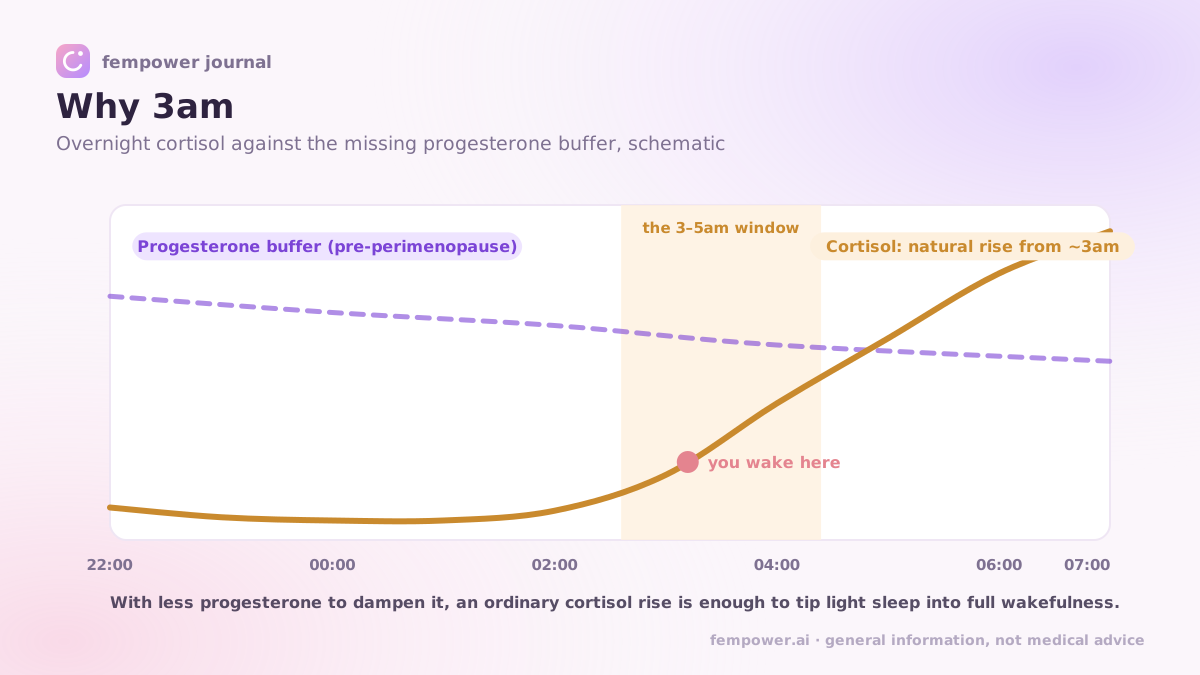
Take that away and you lose a built-in buffer. Sleep becomes lighter and easier to break. Ordinary stress feels less ordinary. The natural rise of cortisol in the early hours, which used to happen under a blanket of progesterone, now lands on a brain with nothing to soften it. That is the mechanism behind waking at 3am.
How low progesterone shows up
These are the symptoms most strongly weighted to low progesterone in Fempower's knowledge base. You do not need all of them, and other drivers often contribute.
- Waking in the early hours, typically between 2am and 4am, often alert and unable to get back to sleep.
- Anxiety that seems to come from nowhere, especially in the week or two before a period.
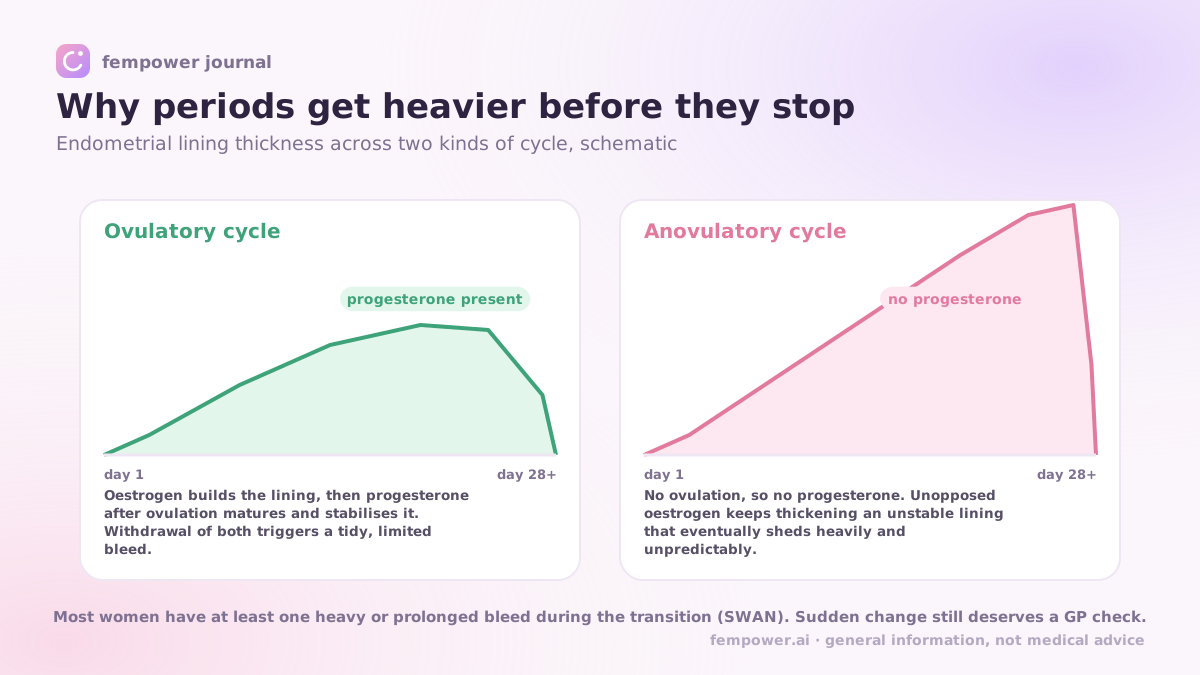
- Heavier or longer periods, sometimes with flooding or clots. Without progesterone to limit it, the lining builds thicker under unopposed oestrogen and sheds more.
- Breast tenderness and bloating, which are signs of oestrogen without its counterweight.
- Shorter cycles in the early stages, as the luteal phase contracts.
What helps
Some things you can try yourself, and some belong in a conversation with a GP.
- Protect sleep structure. A consistent wake time, a cool room, and no alcohol in the three hours before bed all reduce the fragmentation that low progesterone makes more likely.
- Magnesium glycinate in the evening, in the 200 to 300 mg range often used in guidance, is low risk and helps some women. The evidence is modest, so give it two weeks and judge honestly. Check with a GP or pharmacist if you take other medication or have kidney problems. More in magnesium for sleep.
- Track heavy bleeding. Note days, flooding and clots. This is exactly the information a GP needs, and iron deficiency from heavy periods is a common and fixable cause of exhaustion.
- Ask about body-identical progesterone. Micronised progesterone, taken at night, is the form recommended by NICE and the British Menopause Society as part of HRT. Many women notice a sleep benefit specifically from this component.
The short version
Progesterone goes first because it depends on ovulation, and ovulation is what falters earliest. It is the calming hormone, so losing it shows up as broken sleep, new anxiety and heavier periods, often while everything else still looks normal. Knowing that changes what you ask for.
Questions people ask
- Why does progesterone fall before oestrogen in perimenopause?
- Progesterone is only produced after ovulation, by the corpus luteum. As cycles increasingly fail to release an egg, progesterone disappears from those cycles, while the ovaries can still produce oestrogen for years.
- Can low progesterone cause anxiety?
- It can contribute. Progesterone is converted in the brain to allopregnanolone, which enhances the calming GABA system. When progesterone falls, that buffer is reduced, and many women notice new or worse anxiety, especially before a period.
- Does low progesterone cause heavy periods?
- Often, yes. Without progesterone to limit growth, the womb lining builds thicker under oestrogen and sheds more heavily. Very heavy bleeding should always be checked by a GP, as it can have other causes.
- What is micronised progesterone?
- A body-identical form of progesterone, taken as a capsule, usually at night. It is the progestogen recommended by NICE and the British Menopause Society as part of HRT, and many women find it helps sleep.
References
- Perimenopause: the complex endocrinology of the menopausal transition. Endocrine Reviews (Prior JC), 1998.
- Menopause: identification and management (NG23). NICE, 2024.
- Characterization of reproductive hormonal dynamics in the perimenopause. Journal of Clinical Endocrinology & Metabolism (Santoro N et al.), 1996.
- Progestogens and endometrial protection. British Menopause Society, 2023.
- Executive summary of the Stages of Reproductive Aging Workshop + 10. Menopause (Harlow SD et al.), 2012.