Why you wake at 3am in perimenopause
Wide awake at 3am, heart going, mind racing. There is an overnight sequence that produces it, and once you can see it, it makes sense.
- Progesterone
- Cortisol
- Oestrogen
Key takeaways
- Cortisol naturally begins rising at around 3am to get you ready for the day.
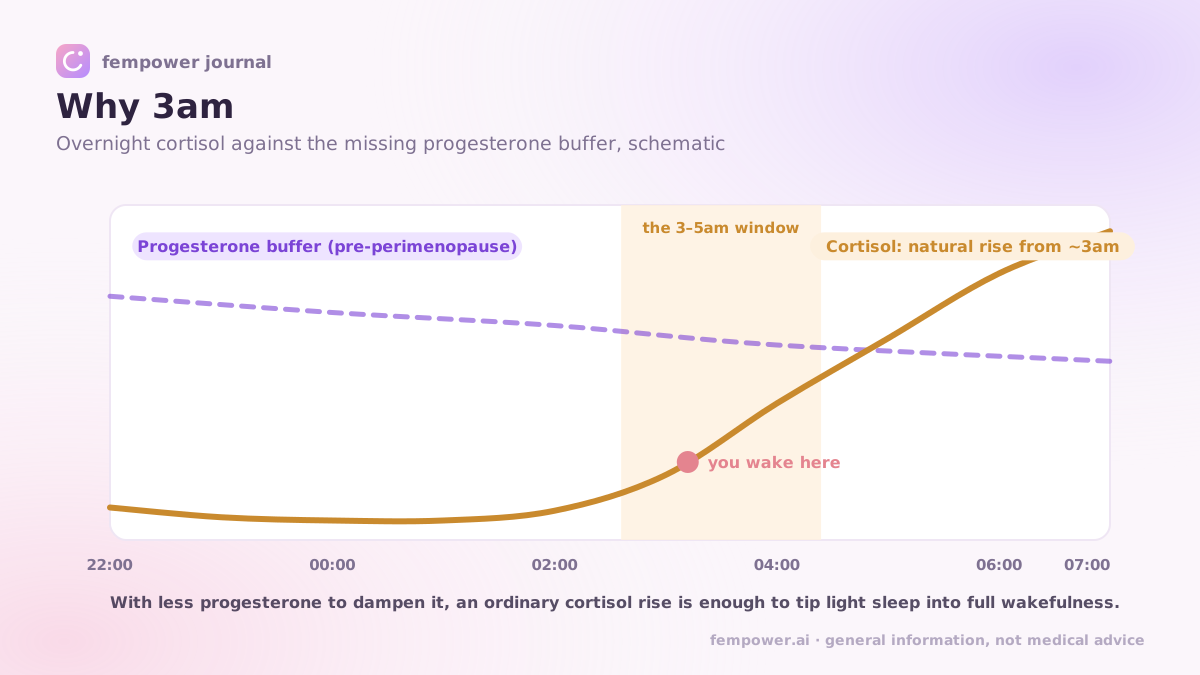
- Progesterone used to buffer that rise. In perimenopause it is often missing, so the rise wakes you.
- A night sweat, alcohol wearing off, or a full bladder can all tip the balance at the same hour.
- Small changes to evening routine and room temperature make a measurable difference for some women.
- Micronised progesterone is the HRT component most associated with better sleep, and worth asking about.
It is one of the most common things women describe in early perimenopause, and one of the least explained. You fall asleep fine. Then somewhere between 2am and 4am you are suddenly awake, often with a racing heart and a mind that will not stop. Getting back to sleep takes an hour, or does not happen at all. The pattern is so consistent that it deserves a proper explanation.
The overnight timeline
Sleep changes shape across the night. Your body moves through several overlapping rhythms, and the early hours are where three of them collide.
- Before midnight, deep sleep dominates. This is when progesterone's calming metabolite, allopregnanolone, does most of its work in a normal cycle.
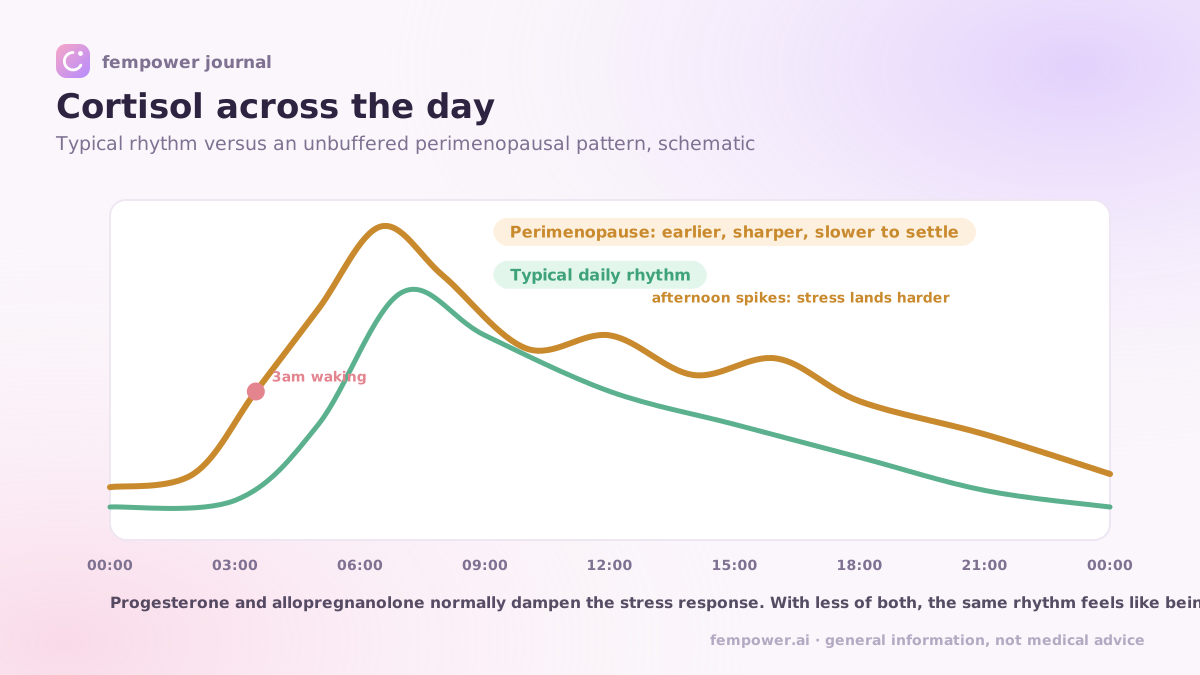
- From around 3am, cortisol begins its daily climb. This is the cortisol awakening response getting under way, your body preparing to be up in a few hours.
- In the same window, core body temperature reaches its lowest and starts to rise again, sleep becomes lighter, and REM periods get longer.
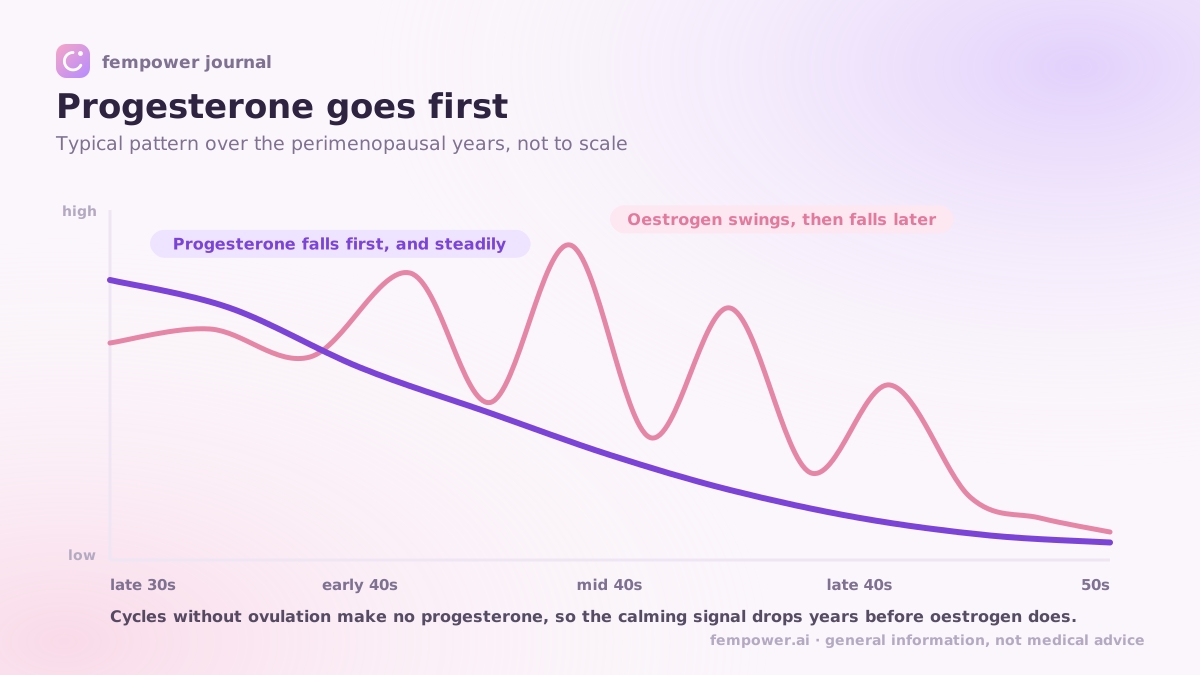
In your thirties, progesterone smoothed the transition through that window. It kept the brain's GABA system responsive enough that the cortisol rise passed unnoticed. In perimenopause, progesterone is often the first hormone to fall, and the same physiological rise now crosses the threshold into wakefulness.
Things that pile on at the same hour
The cortisol rise is the base cause. Several other things tend to land on top of it.
- Night sweats. Falling or swinging oestrogen narrows the range of temperatures your brain tolerates. As core temperature turns upward in the early hours, a small change can trigger a flush, and you wake hot and damp. There is more on the mechanism in hot flushes explained.
- Alcohol rebound. Alcohol is sedating for the first few hours and then the opposite. As it is metabolised it fragments sleep and raises heart rate, and the timing of that rebound is usually the early hours.
- A full bladder. Lower oestrogen affects bladder tissue, and waking to pee becomes more common. Once awake, the cortisol rise makes it harder to drift back.
- A racing mind. Cortisol sharpens attention. At 3am, with nothing to attend to, it attaches to whatever you were worried about yesterday.
What to try tonight
None of these is a cure. Each one nudges the balance, and the point is to find which ones move it for you.
- Cool the room. Aim for a bedroom around 18°C and use layers you can throw off. This reduces the chance that the early-hours temperature rise trips a sweat.
- Move alcohol earlier, or drop it for two weeks. Finish any drinks at least three hours before bed. Many women find this alone removes the 3am waking on the nights they do not drink. Test it honestly.
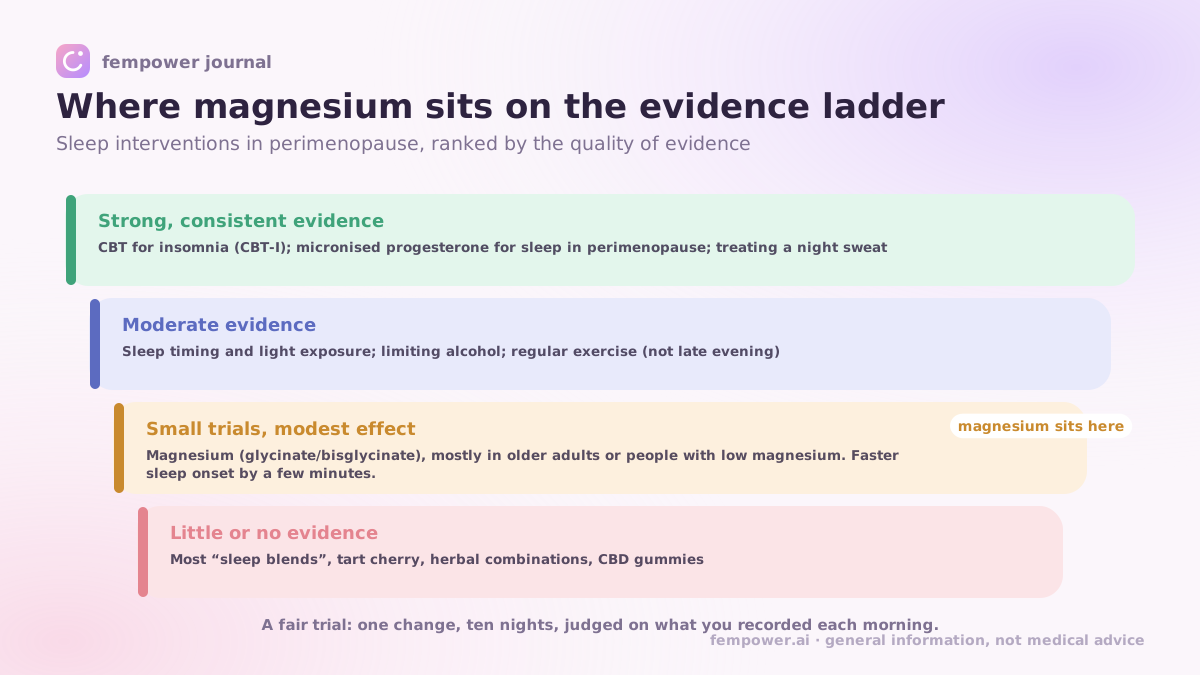
- Magnesium glycinate in the evening. The 200 to 300 mg range commonly used in guidance is low risk for most people. The evidence for sleep is modest but real for some, so give it two weeks. Check with your GP or pharmacist if you take other medication or have kidney problems.
- Borrow from CBT-I. If you are awake more than about twenty minutes, get up, keep the lights low, do something dull, and go back when sleepy. Keep the same wake time every day, even after a bad night. This is the core of cognitive behavioural therapy for insomnia, which NICE recommends for persistent sleep problems.
- Avoid checking the clock. Knowing it is 3:12am adds a layer of dread that cortisol is happy to amplify.
What to ask your GP
If self-help changes have not shifted it after a few weeks, or the waking is wrecking your days, it is worth a proper conversation. The most relevant thing to know going in is that not all HRT is equal for sleep. Micronised progesterone, the body-identical form taken at night, is the component most consistently associated with improved sleep, and it is the progestogen recommended by NICE and the British Menopause Society. Some women are offered a different progestogen that does not have the same effect.
The short version
The 3am wake-up is a normal cortisol rise landing on a brain that has lost its progesterone buffer, sometimes with a night sweat or alcohol rebound on top. Once you know the mechanism, there are things that help and a clear thing to ask for. See the FAQ for related questions.
Questions people ask
- Why do I wake up at 3am every night in perimenopause?
- Cortisol starts its normal daily rise at around 3am. Progesterone used to buffer that rise, but it falls early in perimenopause, so the same rise now wakes you. Night sweats and alcohol wearing off often add to it.
- Does alcohol make 3am waking worse?
- Usually, yes. Alcohol is sedating at first and then fragments sleep as it is metabolised, and that rebound tends to happen in the early hours. Stopping drinks at least three hours before bed, or a two-week break, is a simple test.
- Does HRT help with waking at 3am?
- It can. Micronised progesterone, the body-identical form taken at night, is the HRT component most associated with better sleep. It is worth asking your GP about specifically, as other progestogens may not have the same effect.
- Is magnesium good for perimenopause sleep?
- The evidence is modest but some women find it helps. Magnesium glycinate in the 200 to 300 mg range in the evening is low risk for most people. Check with a GP or pharmacist if you take other medication or have kidney problems.
References
- Menopause: identification and management (NG23). NICE, 2024.
- Perimenopause: the complex endocrinology of the menopausal transition. Endocrine Reviews (Prior JC), 1998.
- Menopausal hot flashes: mechanisms, endocrinology, treatment. Journal of Steroid Biochemistry and Molecular Biology (Freedman RR), 2014.
- HRT: practical prescribing. British Menopause Society, 2023.
- Duration of menopausal vasomotor symptoms over the menopause transition. JAMA Internal Medicine (Avis NE et al., SWAN), 2015.