Hot flushes: what is happening in your brain
A hot flush starts with the brain's thermostat, and the skin only reports it. Your brain's tolerance for small changes narrows, and the fix is to widen it again.
- Oestrogen
Key takeaways
- A hot flush is triggered by the brain's thermostat, in the hypothalamus, misjudging a tiny rise in core temperature.
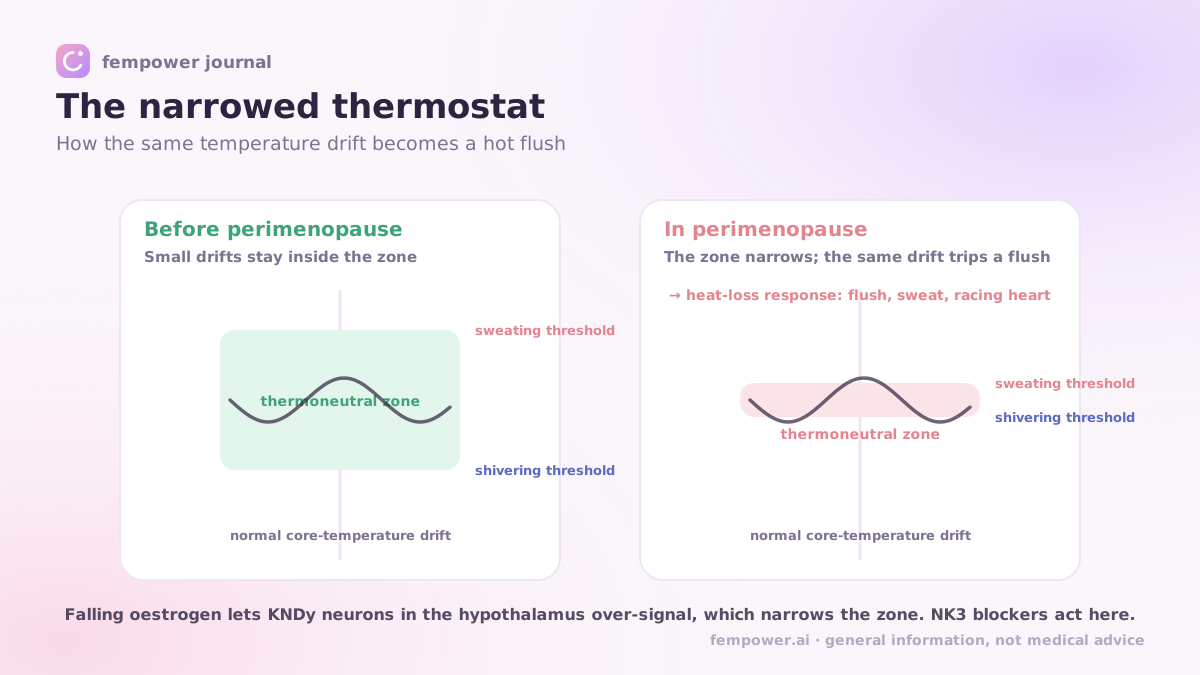
- Falling oestrogen narrows the thermoneutral zone, so the threshold for sweating is crossed far more easily.
- A group of brain cells called KNDy neurons grow and become overactive without oestrogen. This is the target of the newest non-hormonal drugs.
- In the SWAN study, flushes lasted a median of 7.4 years, and longer for women whose flushes started early.
- HRT, CBT and neurokinin-blocking drugs all have good evidence. Triggers like alcohol, heat and stress are worth managing but rarely enough alone.
A hot flush feels like your body overheating, and yet your core temperature has usually risen by only a fraction of a degree. What has changed is that your brain now treats that fraction as an emergency and launches a full cooling response: blood rushes to the skin, you sweat, your heart speeds up, and thirty seconds to a few minutes later it is over and you are chilled and damp. The problem is in the thermostat.
The thermostat in your head
Body temperature is regulated by the hypothalamus, a small region at the base of the brain. It keeps core temperature inside a narrow band by triggering shivering when you fall below the lower limit and sweating and skin flushing when you rise above the upper one. Between those limits is the thermoneutral zone, where the brain does nothing because nothing needs doing.
The physiologist Robert Freedman spent years measuring this zone in women with and without hot flushes. In women without flushes it is around 0.4°C wide. In women with frequent flushes it is close to zero. A cup of tea, a warm room, a moment of stress, or the natural early-morning rise in core temperature is enough to cross the line. That is the whole story of a flush: a normal fluctuation meeting a threshold that has moved.
Where oestrogen comes in
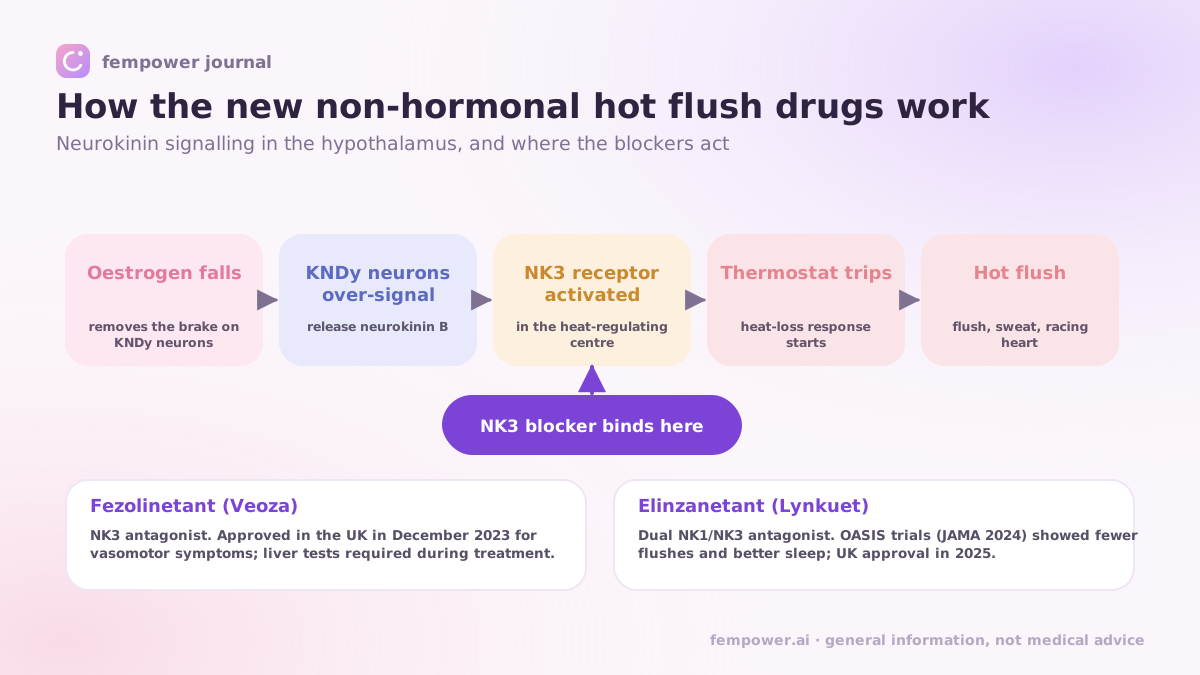
The thermostat narrows because oestrogen falls, and the link runs through a group of nerve cells in the hypothalamus called KNDy neurons, named for the three chemical messengers they produce: kisspeptin, neurokinin B and dynorphin. Their day job is regulating the reproductive cycle. Oestrogen normally keeps them in check.
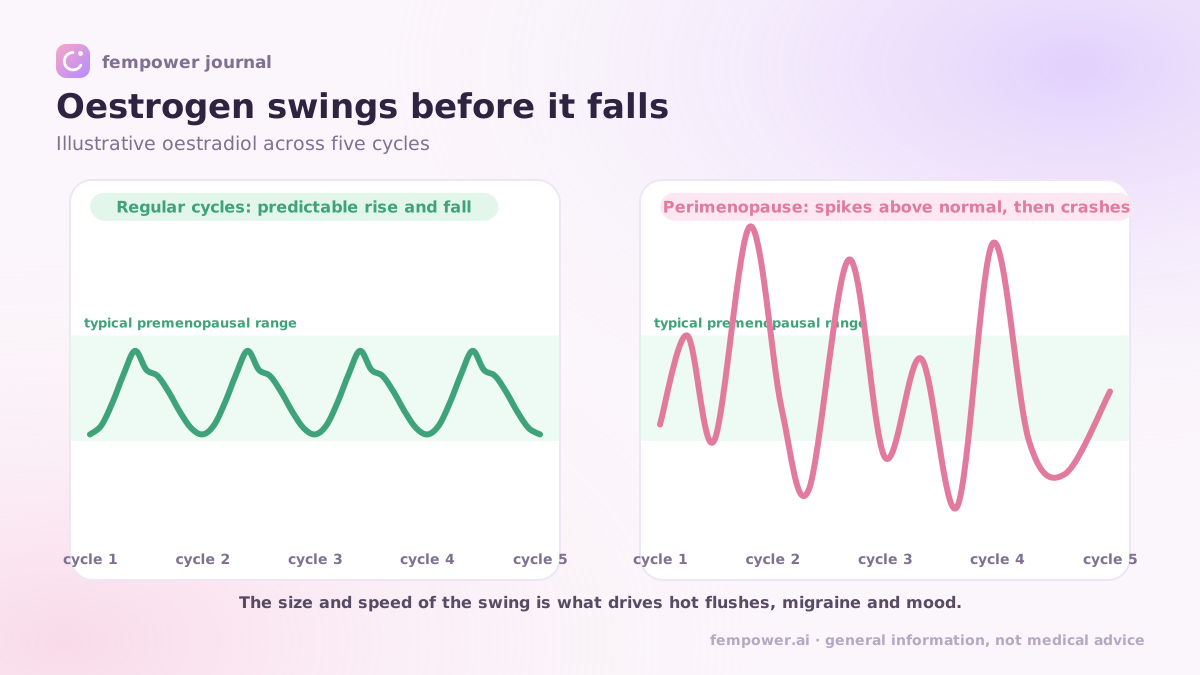
The neuroscientist Naomi Rance showed that in postmenopausal women these neurons become dramatically enlarged and overactive. With no oestrogen to restrain them, they pump out neurokinin B, and neurokinin B signals into the temperature-control circuits next door. The result is a thermostat that keeps getting nudged towards "too hot". This explains why flushes track oestrogen drops more than absolute levels, which we cover in oestrogen doesn't just fall, it swings. It also explains why blocking neurokinin B directly stops flushes, which is what the newest drugs do.
How long they last
Longer than most women are told. The SWAN study followed over 1,400 women with frequent hot flushes and night sweats and found they lasted a median of 7.4 years, with roughly 4.5 of those years after the final period. Women whose flushes began early in the transition had them longest, sometimes over eleven years. Women whose flushes started after their last period had them for shorter. Those numbers are the reason clinicians stopped saying "it will pass in a year or two". There is more on the study in how long perimenopause lasts.
Triggers, and what they can and cannot do
Because the zone is so narrow, anything that nudges core temperature or activates the stress response can set off a flush. Managing triggers reduces how often you cross the line, even though the zone itself stays narrow.
- Heat: warm rooms, hot drinks, spicy food, hot baths before bed. Layers and a cool bedroom matter.
- Alcohol, which dilates blood vessels and disrupts overnight temperature control. Many women see night sweats fall sharply on nights they do not drink.
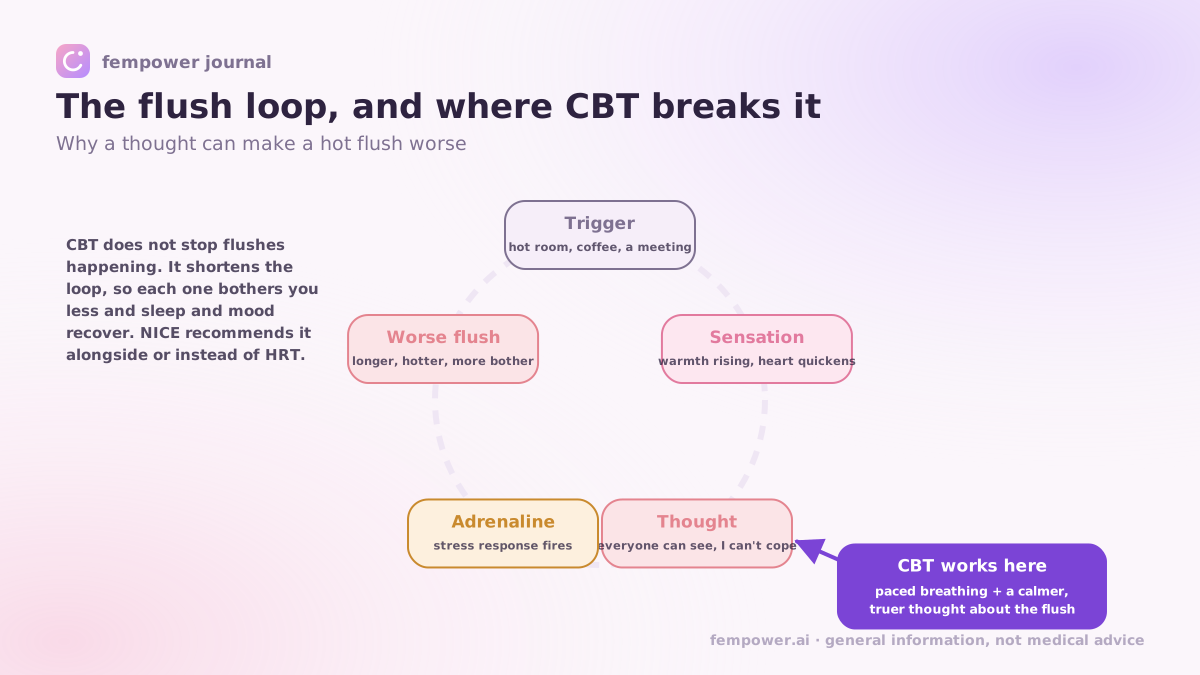
- Stress and anxiety, which raise heart rate and core temperature. Slow breathing at the first sign of a flush measurably shortens it for some women.
- Caffeine, for some. Not everyone is sensitive, so test it.
- Smoking, which is consistently associated with more frequent and severe flushes.
Treatments with real evidence
- HRT is the most effective treatment for hot flushes and night sweats, and NICE recommends it as first-line for most women. Oestrogen restores the restraint on KNDy neurons and widens the thermoneutral zone.
- Cognitive behavioural therapy designed for menopause reduces how much flushes bother you and how much they disrupt sleep, with good trial evidence. NICE added it to the guideline in 2024. See CBT for menopause symptoms.
- Neurokinin receptor antagonists, fezolinetant and elinzanetant, block the neurokinin B signal directly. They are non-hormonal, licensed in the UK, and reduce flush frequency substantially in trials. We explain them in the new hot flush drugs.
- Some antidepressants and other non-hormonal medicines have moderate evidence and are options when HRT is unsuitable. Your GP can talk through them.
The short version
A hot flush is your brain's thermostat overreacting to a normal fluctuation, because falling oestrogen has let a group of neurons narrow the band it tolerates. That is why flushes follow each drop, why they can last for years, and why every treatment that works acts on the thermostat itself.
Questions people ask
- What causes hot flushes in perimenopause?
- Falling oestrogen narrows the thermoneutral zone in the hypothalamus, the brain's thermostat. Small rises in core temperature then cross the sweating threshold. Overactive KNDy neurons, releasing neurokinin B, are the link between low oestrogen and the narrowed zone.
- How long do hot flushes last?
- In the SWAN study, frequent hot flushes and night sweats lasted a median of 7.4 years, with about 4.5 years continuing after the final period. Women whose flushes started early in perimenopause tended to have them longest.
- What is the most effective treatment for hot flushes?
- HRT is the most effective treatment and is recommended first-line by NICE for most women. Cognitive behavioural therapy and the newer non-hormonal drugs fezolinetant and elinzanetant also have strong evidence.
- Does alcohol trigger hot flushes?
- For many women, yes. Alcohol dilates blood vessels and disrupts overnight temperature regulation, which makes it easier to cross the narrowed sweating threshold. A short break from alcohol is a simple way to test its effect on you.
- What are KNDy neurons?
- A group of cells in the hypothalamus that produce kisspeptin, neurokinin B and dynorphin. Oestrogen normally restrains them. Without it they enlarge and become overactive, and their neurokinin B output disturbs the neighbouring temperature-control circuits, causing flushes.
References
- Menopausal hot flashes: mechanisms, endocrinology, treatment. Journal of Steroid Biochemistry and Molecular Biology (Freedman RR), 2014.
- Duration of menopausal vasomotor symptoms over the menopause transition. JAMA Internal Medicine (Avis NE et al., SWAN), 2015.
- Modulation of body temperature and LH secretion by hypothalamic KNDy (kisspeptin, neurokinin B and dynorphin) neurons: a novel hypothesis on the mechanism of hot flushes. Frontiers in Neuroendocrinology (Rance NE et al.), 2013.
- Menopause: identification and management (NG23). NICE, 2024.
- Cognitive behaviour therapy (CBT) for menopausal symptoms. British Menopause Society, 2023.