New non-hormonal hot flush drugs: fezolinetant and elinzanetant
For the first time there are drugs that stop hot flushes at the source in the brain without using hormones. How they work, what the trials found, and who they might suit.
- Oestrogen
Key takeaways
- Hot flushes start in a small group of hypothalamic neurons that become over-active when oestrogen falls.
- Fezolinetant blocks the NK3 receptor those neurons use. Elinzanetant blocks NK3 and NK1.
- Both roughly halve hot flush frequency in trials, and elinzanetant also improved sleep.
- They suit women who cannot or would prefer not to take HRT. They are not HRT, so they do not protect bone or treat vaginal symptoms.
- Fezolinetant needs liver blood tests. Both are new, so long-term data is still accumulating.
For decades the choice for hot flushes was HRT or an off-label antidepressant. In the past three years that has changed. Two drugs now exist that act on the exact brain circuit that produces a flush, without touching your hormones. This post explains the mechanism in plain terms, summarises the trials, and sets out honestly who they suit and what they leave untreated.
Where a hot flush starts
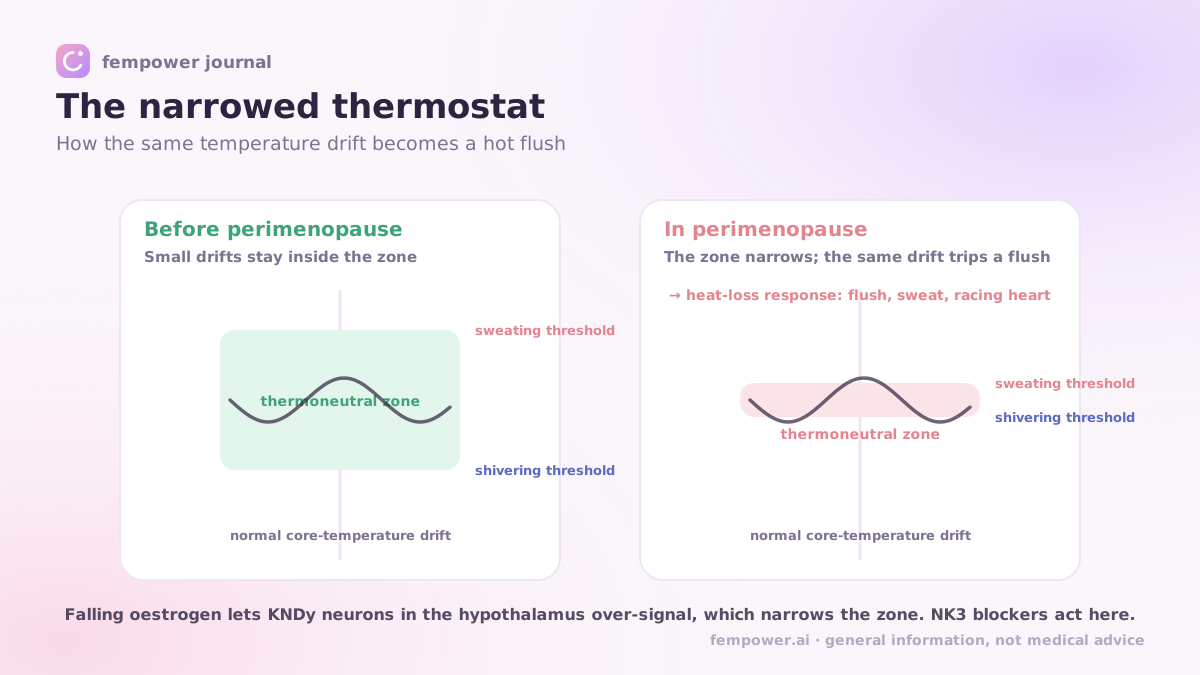
A hot flush begins in the hypothalamus, the part of the brain that sets body temperature, long before you feel it in your skin. A small cluster of cells there, called KNDy neurons after the three signalling chemicals they release (kisspeptin, neurokinin B and dynorphin), is normally held in check by oestrogen.
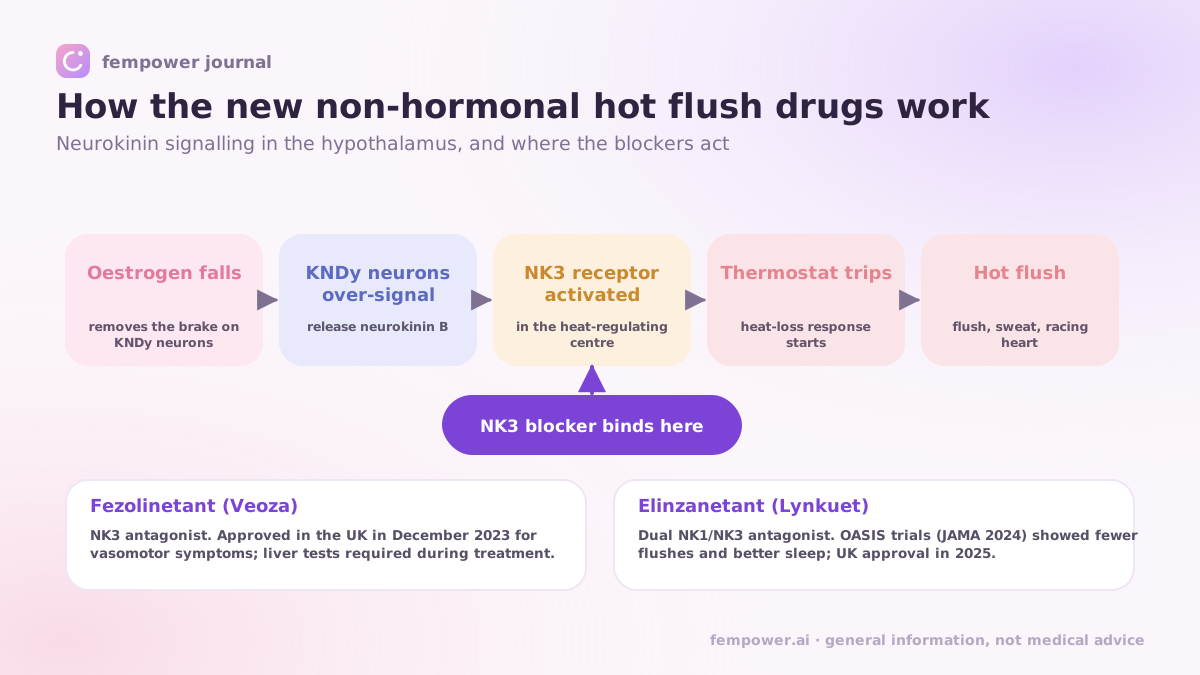
As oestrogen falls in perimenopause, that brake comes off. The KNDy neurons enlarge and fire more, releasing more neurokinin B onto the neighbouring thermostat circuit. The thermostat becomes hypersensitive: the range of core temperatures it treats as "fine" narrows to almost nothing. A tiny rise, from a warm room, a coffee, a moment of stress, tips it into full cooling mode. Blood rushes to the skin, you sweat, your heart rate climbs. That is a flush.
How the new drugs cut the wire
Neurokinin B does its work by binding to a receptor called NK3. Block the receptor and the over-active neurons can shout as loudly as they like, but the thermostat does not hear them. That is the whole idea, and it is why these drugs work without replacing oestrogen at all.
- Fezolinetant (brand name Veoza in the UK, Veozah in the US) is a selective NK3 receptor antagonist, taken as one tablet daily.
- Elinzanetant (brand name Lynkuet) blocks both NK3 and NK1 receptors. The NK1 receptor is involved in sleep and mood regulation, which may explain its extra effect on sleep.
What the trials showed
Fezolinetant was tested in the SKYLIGHT programme. In SKYLIGHT 1, published in The Lancet in 2023, women with moderate to severe hot flushes taking fezolinetant had substantially fewer and milder flushes than those on placebo by week 12, with the difference visible within the first week. Reductions in frequency were in the region of 60 per cent, against a placebo response that was itself sizeable, as it always is in hot flush trials.
Elinzanetant was tested in the OASIS trials. OASIS 1 and 2, published together in JAMA in 2024, found a similar scale of reduction in hot flush frequency and severity, and, notably, a measurable improvement in sleep disturbance and menopause-related quality of life. OASIS 3 extended the follow-up to a year.
Fezolinetant was approved by the MHRA in December 2023 and was later recommended by NICE for NHS use for women who cannot or do not want to take HRT. Elinzanetant received UK approval in 2025. At the time of writing, NHS availability and local prescribing rules for elinzanetant vary, so ask locally.
Who they are for
These drugs were developed for women with troublesome flushes and sweats who cannot take HRT, for example after a hormone-sensitive breast cancer, or who have weighed it up and would rather not. For those women they are a real step forward, because the previous non-hormonal options worked less well and carried their own side effects.
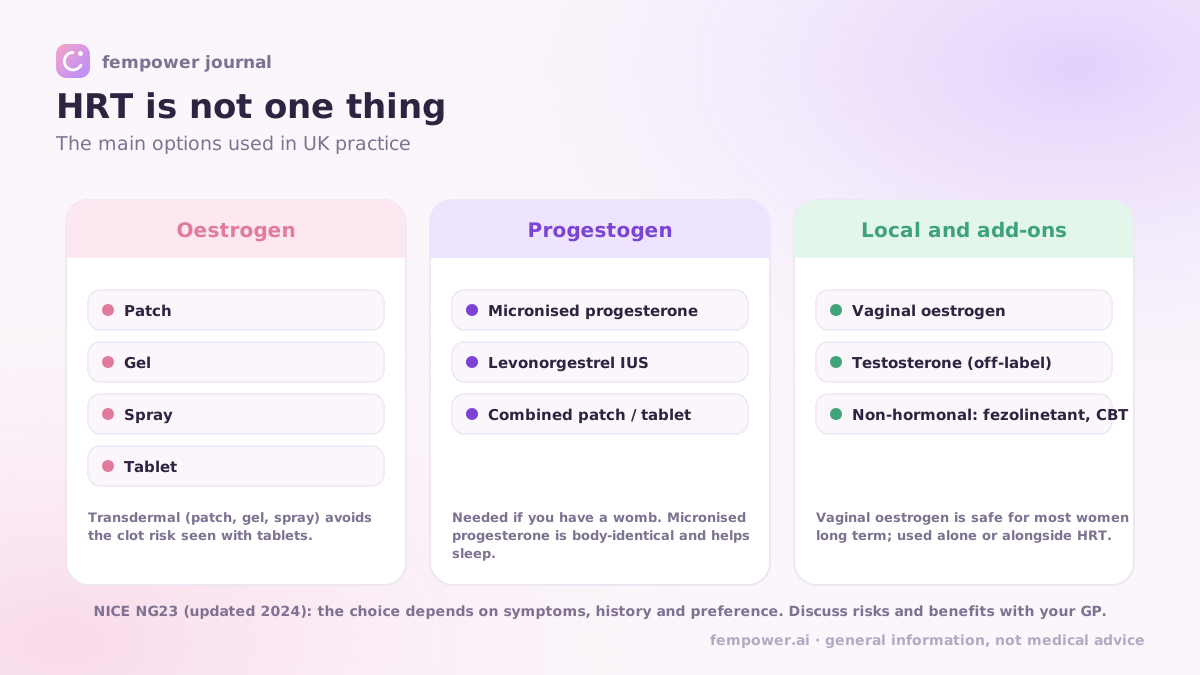
For a woman who can take HRT and has a range of symptoms, HRT usually remains the first-line option, because it treats more than one thing at once.
What they do not do
This part tends to get lost in the headlines. These drugs replace nothing, so everything else oestrogen does in the body stays untreated:
- They do not protect bone density.
- They do not treat vaginal dryness, urinary symptoms or recurrent UTIs.
- They are not expected to help joint aches, brain fog or low libido, which are driven by other oestrogen and testosterone effects.
- Fezolinetant requires liver function tests before starting and at intervals during the first months, after reports of liver injury in a small number of users.
They are also new. Trial follow-up runs to about a year, and real-world safety data is still being gathered. That is a reason to have the conversation with a clinician who knows your history, and to go in with your eyes open.
Questions people ask
- How do fezolinetant and elinzanetant work?
- They block neurokinin receptors in the hypothalamus. When oestrogen falls, KNDy neurons over-signal and trip the brain's thermostat, causing a hot flush. Blocking the NK3 receptor (and NK1 for elinzanetant) stops that signal without using hormones.
- Are they available on the NHS?
- Fezolinetant was approved by the MHRA in December 2023 and later recommended by NICE for women who cannot or do not want to take HRT. Elinzanetant was approved in the UK in 2025. Local availability varies, so ask your GP.
- Are they a replacement for HRT?
- No. They treat hot flushes and night sweats only. They do not protect bone, treat vaginal or urinary symptoms, or help with the other effects of low oestrogen.
- Do they have side effects?
- Fezolinetant requires liver function monitoring because of rare reports of liver injury. Both drugs are new, so long-term data is still being collected. Discuss your own history with a clinician.
References
- Fezolinetant for treatment of moderate-to-severe vasomotor symptoms associated with menopause (SKYLIGHT 1). The Lancet (Lederman S et al.), 2023.
- Elinzanetant for the Treatment of Vasomotor Symptoms Associated With Menopause: OASIS 1 and 2 Randomized Clinical Trials. JAMA (Pinkerton JV et al.), 2024.
- Menopause: identification and management (NG23). NICE, 2024.
- Neurokinin B and the hypothalamic control of vasomotor symptoms. Rance NE et al., Frontiers in Neuroendocrinology, 2013.