Anxiety from nowhere: progesterone, GABA and allopregnanolone
Nothing is wrong, and yet your heart is going and your mind is racing. Perimenopausal anxiety has a mechanism, and it starts with a progesterone metabolite most people have never heard of.
- Progesterone
- Oestrogen
- Cortisol
Key takeaways
- Progesterone is converted into allopregnanolone, which acts on the same GABA-A receptors as sedatives.
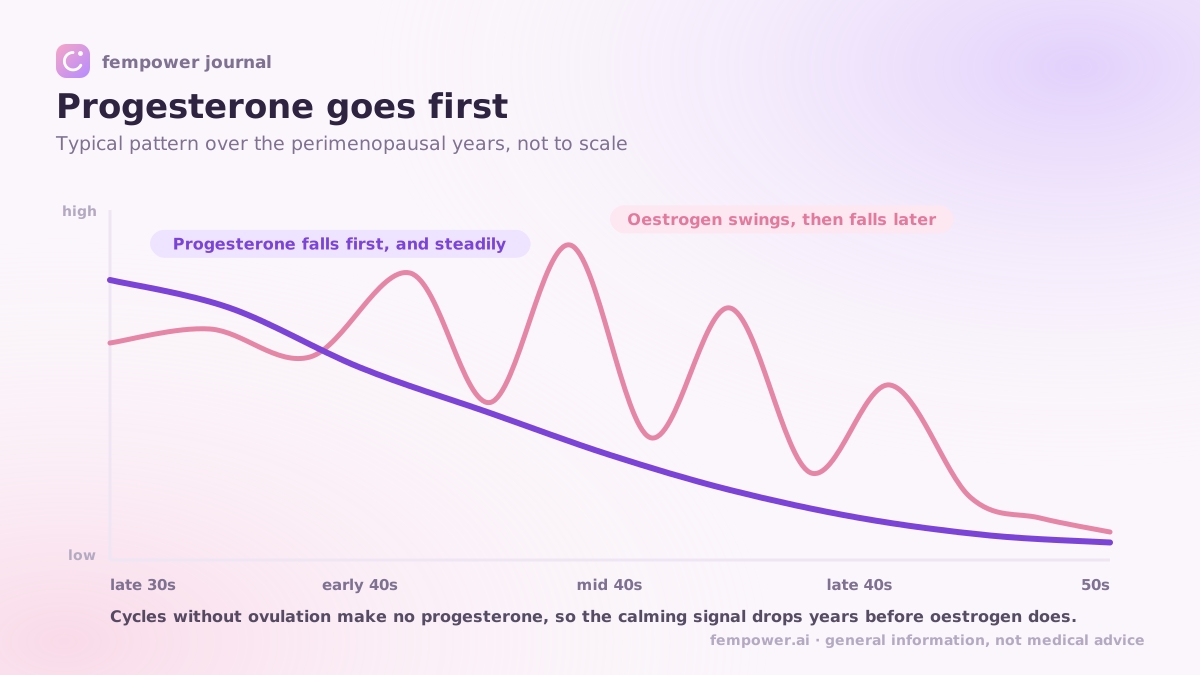
- As ovulation becomes patchy in perimenopause, that built-in calming signal drops, often years before oestrogen falls.
- Oestrogen swings also affect serotonin, so mood can turn without an obvious trigger.
- Anxiety that clusters in the week before a period or at 3am points to hormones rather than a primary anxiety disorder.
- NICE says HRT can be considered for low mood linked to the menopause. Antidepressants are not first-line for that alone.
The distinctive thing about perimenopausal anxiety is that it does not need a reason. You are not worried about anything in particular. You simply wake with a sense of dread, or feel your chest tighten in the supermarket, or lie awake with your thoughts sprinting. Women who have never been anxious in their lives describe it as feeling like a different person. There is a reason for it, and knowing the reason changes how you think about yourself.
The brain's own sedative
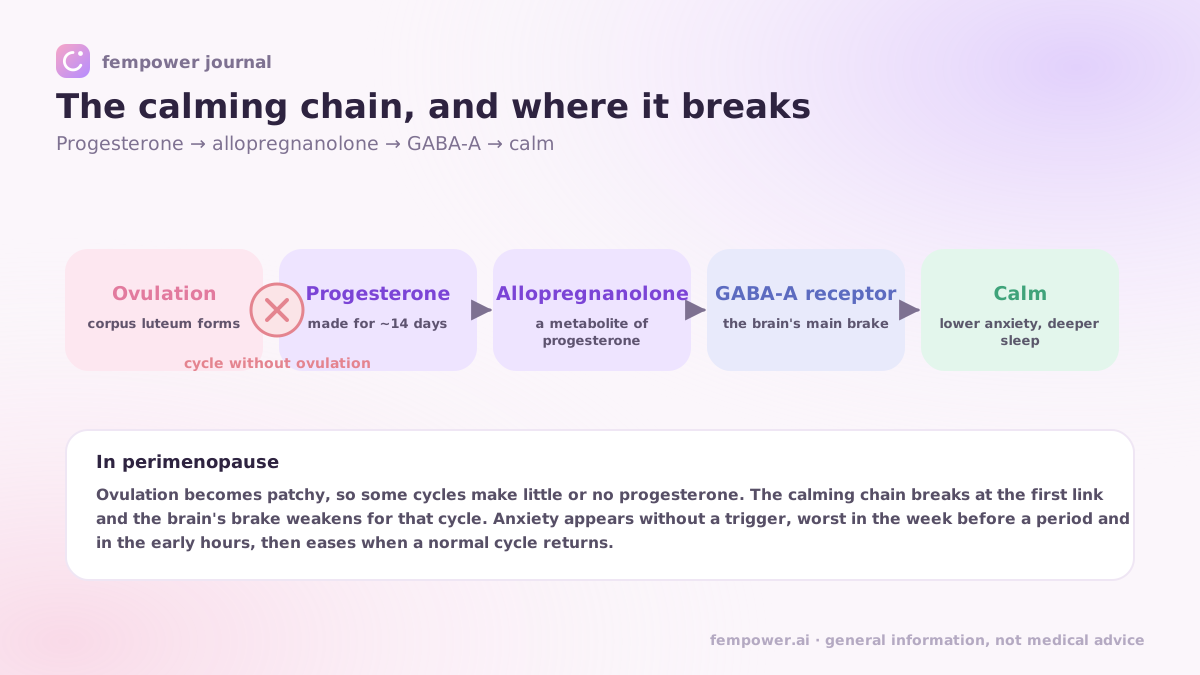
Progesterone is best known as the hormone of the second half of the cycle, produced after ovulation to prepare the womb lining. But it has a second life. In the brain, an enzyme converts progesterone into allopregnanolone, a neurosteroid that binds to GABA-A receptors. GABA is the brain's main inhibitory neurotransmitter, the signal that says slow down. GABA-A receptors are the same ones targeted by benzodiazepines, alcohol and most sleeping tablets. Allopregnanolone turns up their sensitivity. It is, quite literally, your own built-in tranquilliser, and it rises and falls with progesterone across every cycle.
This is why the second half of a normal cycle often feels calmer and sleepier than the first. It is also why the last few days before a period, when progesterone drops sharply, can bring irritability and tension even in women who are nowhere near perimenopause.
What changes in perimenopause
Ovulation becomes unreliable. Some months an egg is released and progesterone follows. Other months it is not, and progesterone barely rises at all. Because progesterone is usually the first hormone to fall, often years before oestrogen, the supply of allopregnanolone becomes patchy while everything else looks normal. The calming signal that used to arrive every month starts missing appointments. Jerilynn Prior's work on the endocrinology of the transition, published in Endocrine Reviews in 1998, laid this out clearly. Perimenopause, in that account, is erratic oestrogen with progressively less progesterone to balance it.
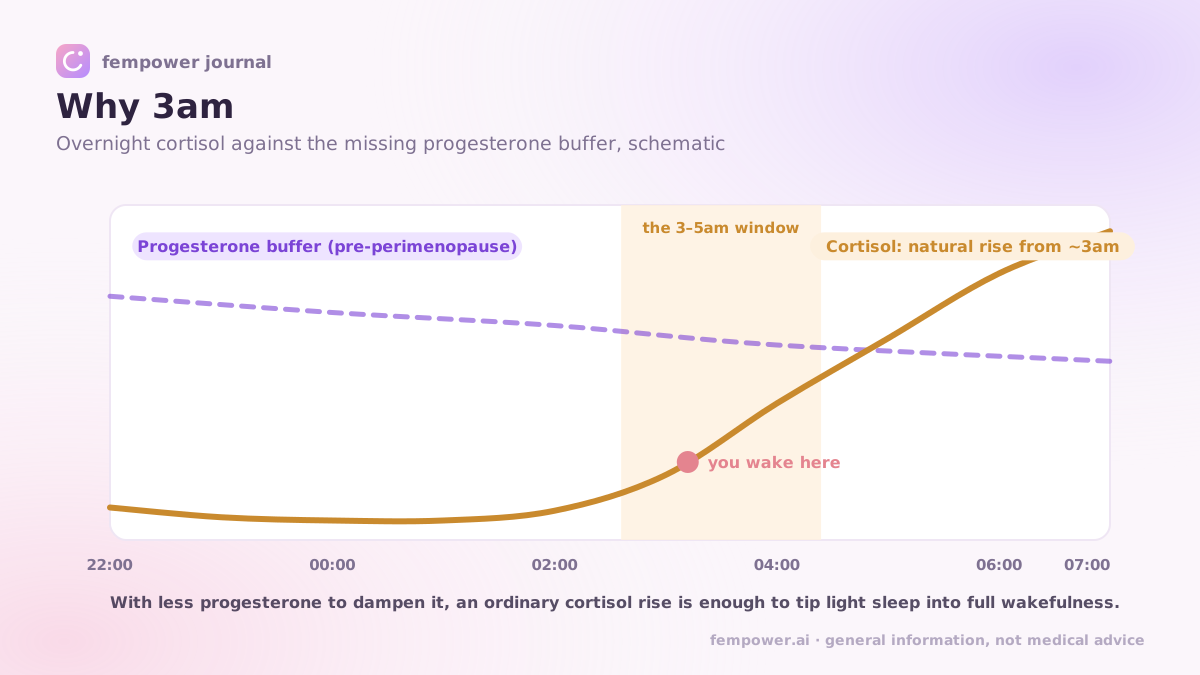
There is a second pathway. Oestrogen influences how serotonin is made, released and cleared. When oestrogen swings, serotonin signalling swings with it. That is a plausible reason why mood can shift day to day with no external cause. And with less progesterone to dampen the stress response, the ordinary early-morning rise in cortisol can land as a jolt.
The pattern that gives it away
Hormonal anxiety has a shape. It tends to be worst in the week before a period, when progesterone drops, and at 3am, when cortisol begins its natural climb without the usual buffer. It often improves in the days after bleeding starts. It comes in waves. And it may arrive with other perimenopausal signs: night sweats, heavier or shorter cycles, breast tenderness, new headaches.
A generalised anxiety disorder looks different. The worry usually has content, even if it moves from topic to topic. It is present most days for months, without a clear cyclical pattern. It does not track your period. Both can exist at once, and a history of anxiety or premenstrual mood symptoms makes the perimenopausal version more likely. But if you can draw your anxiety on a calendar and it lines up with your cycle, that is meaningful.
What the guidance says about treatment
This matters because perimenopausal anxiety is frequently treated as if it were a primary mental health problem. The updated NICE menopause guideline, NG23, is explicit. HRT can be considered for low mood and anxiety that arise as a result of the menopause. And antidepressants such as SSRIs should not be offered as first-line treatment for low mood that is associated with the menopause alone, unless a woman has been diagnosed with depression. Many women are prescribed antidepressants for symptoms that would respond to hormones, and antidepressants do not treat the underlying hormonal cause.
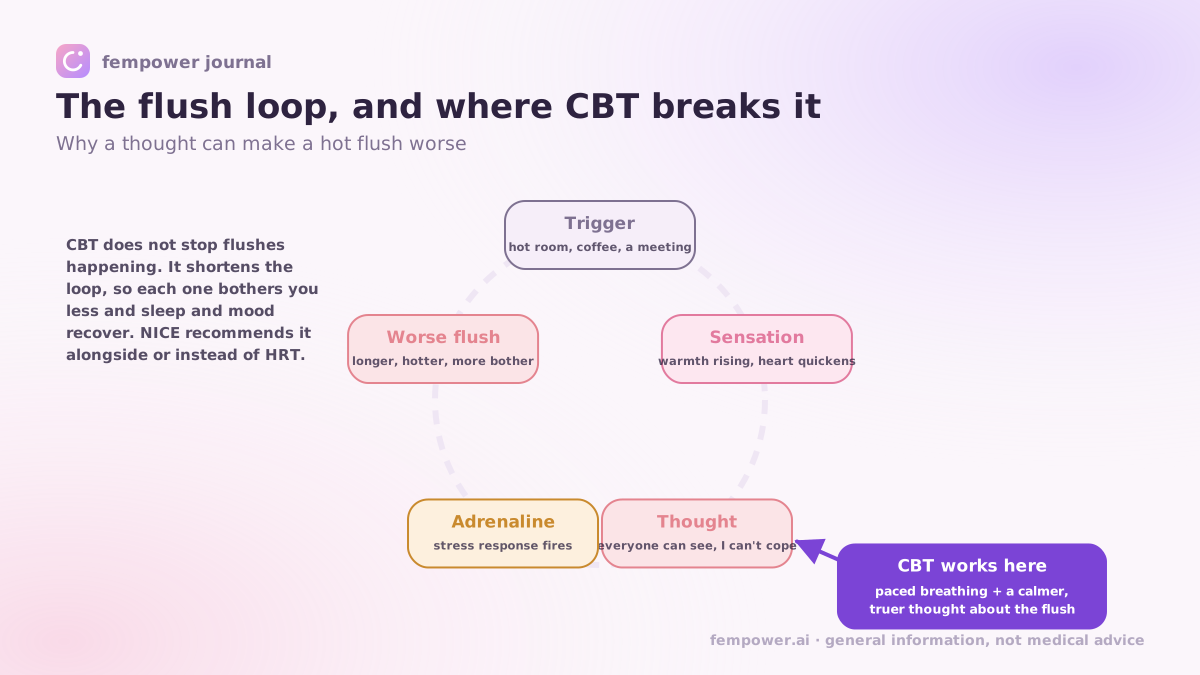
Antidepressants remain appropriate and effective for depression and for some women with severe anxiety. The point is to get the diagnosis right first. NICE also recommends cognitive behavioural therapy for menopause-related low mood and anxiety, with good evidence behind it. You can read more in our post on CBT for menopause symptoms.
Things that help in the meantime
- Name it. Recognising an anxiety wave as hormonal, with a mechanism and a likely end point, takes some of its power away.
- Slow breathing. Extending the out-breath for a few minutes activates the parasympathetic nervous system. It is fast and free, and it takes the edge off.
- Protect sleep. Anxiety and sleep loss feed each other. Cool room, no screens late, and treat the 3am waking as its own problem.
- Watch caffeine and alcohol. Both worsen anxiety, and alcohol wrecks the second half of the night in particular.
- Move daily. Regular exercise reduces anxiety about as well as many treatments, and improves sleep too.
- Magnesium. Some women find it helps sleep and tension. The evidence is modest. Check with your GP or pharmacist before starting a supplement.
The anxiety comes from a chain of chemistry with a broken link, and it can be understood, tracked and treated. Our FAQ covers how the app handles mood and what it will not do.
Questions people ask
- Why does perimenopause cause anxiety?
- Progesterone is converted in the brain into allopregnanolone, which acts on GABA-A receptors to produce calm. As ovulation becomes patchy in perimenopause, progesterone and therefore allopregnanolone drop, removing a built-in calming signal. Oestrogen swings also affect serotonin.
- Why is my anxiety worse before my period?
- Progesterone falls sharply in the days before a period, and with it allopregnanolone. In perimenopause that fall is often from a lower starting point, so the effect is larger.
- How can I tell hormonal anxiety from an anxiety disorder?
- Hormonal anxiety usually comes in waves, is worst before a period or at 3am, and often has no specific content. An anxiety disorder tends to be present most days for months without a cyclical pattern. Both can coexist, so a GP assessment is worthwhile.
- Should I take antidepressants for perimenopausal anxiety?
- NICE guidance says antidepressants should not be first-line for low mood associated with the menopause alone, unless depression has been diagnosed. HRT and CBT are the options it recommends considering first. Discuss the choice with your GP.
References
- Perimenopause: the complex endocrinology of the menopausal transition. Endocrine Reviews (Prior JC), 1998.
- Menopause: identification and management (NG23). NICE, 2024.
- Progesterone reduces wakefulness in sleep EEG and has no effect on cognition in healthy postmenopausal women. Psychoneuroendocrinology (Schüssler P et al.), 2008.
- Mood and the menopause. British Menopause Society, 2023.