Heavy, flooding periods in your forties: why they happen
Most people expect periods to fade out. For many women they get dramatically heavier first. The explanation is a cycle without ovulation, and it is worth understanding.
- Progesterone
- Oestrogen
Key takeaways
- Periods often get heavier and less predictable in perimenopause before they space out and stop.
- The cause is usually a cycle without ovulation, where oestrogen thickens the lining and no progesterone arrives to control it.
- The SWAN study found that most women experience heavy or prolonged bleeding during the transition.
- Heavy bleeding drains iron. Low ferritin causes fatigue, breathlessness and brain fog before anaemia shows.
- Bleeding between periods, after sex, after 12 months without a period, or soaking through in an hour needs a GP.
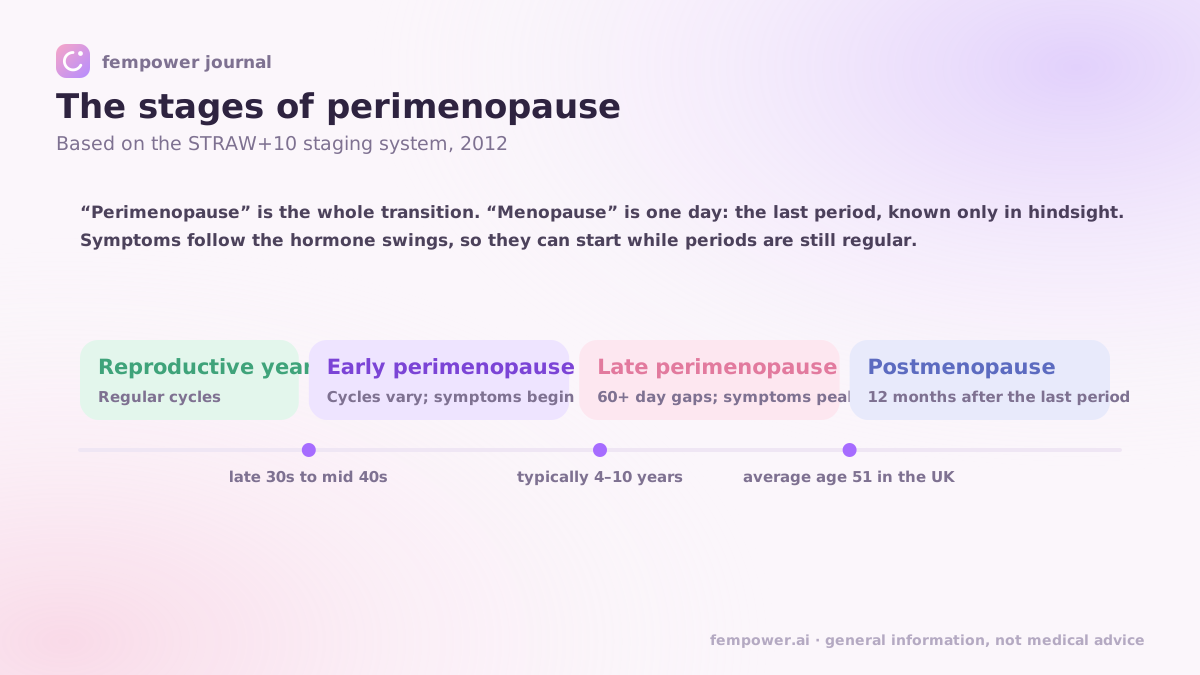
The period arrives without warning, or ten days early, or after a six-week gap. It floods through everything in an hour. There are clots. It goes on for nine days, stops, and starts again. If this is new, and you are in your forties, you are almost certainly not imagining that something has changed. You are also not alone. Heavy bleeding is one of the most common and least discussed features of perimenopause, and it has a clear mechanism.
What a normal cycle does
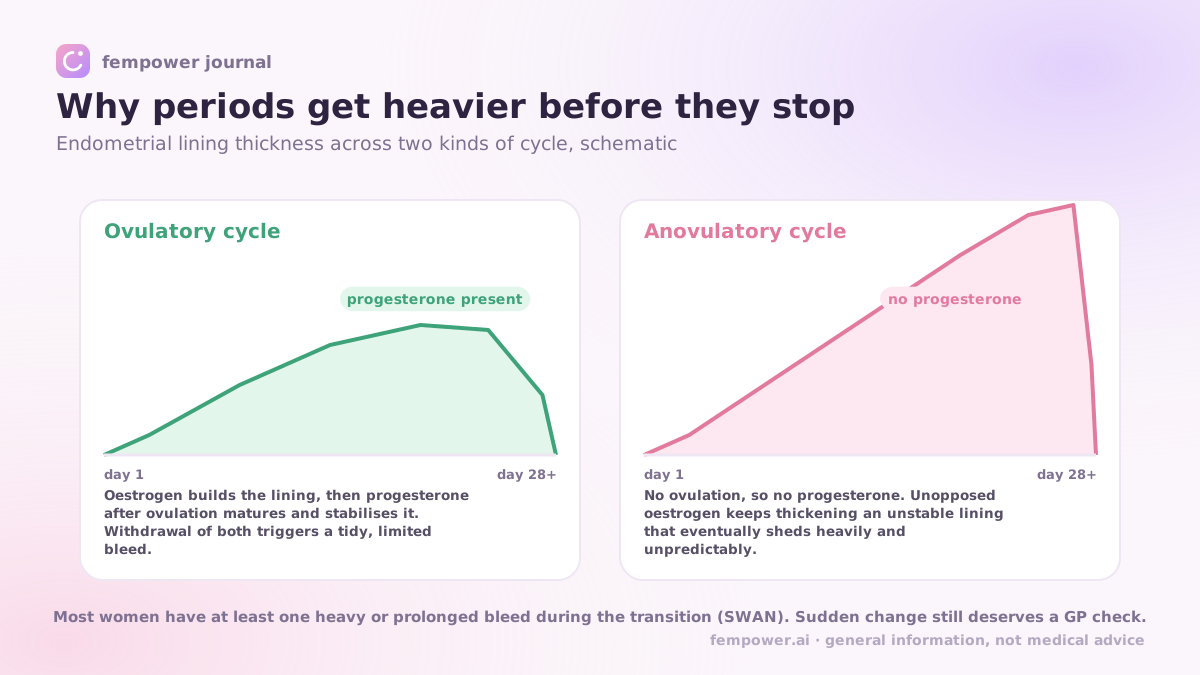
In the first half of a cycle, oestrogen builds the lining of the womb. Then ovulation happens, and the empty follicle becomes the corpus luteum, which produces progesterone. Progesterone stops the lining growing, makes it stable and organised, and when it falls at the end of the cycle, the lining sheds in a controlled way. The bleed is predictable in timing, amount and duration because progesterone was in charge of the second half.
What an anovulatory cycle does
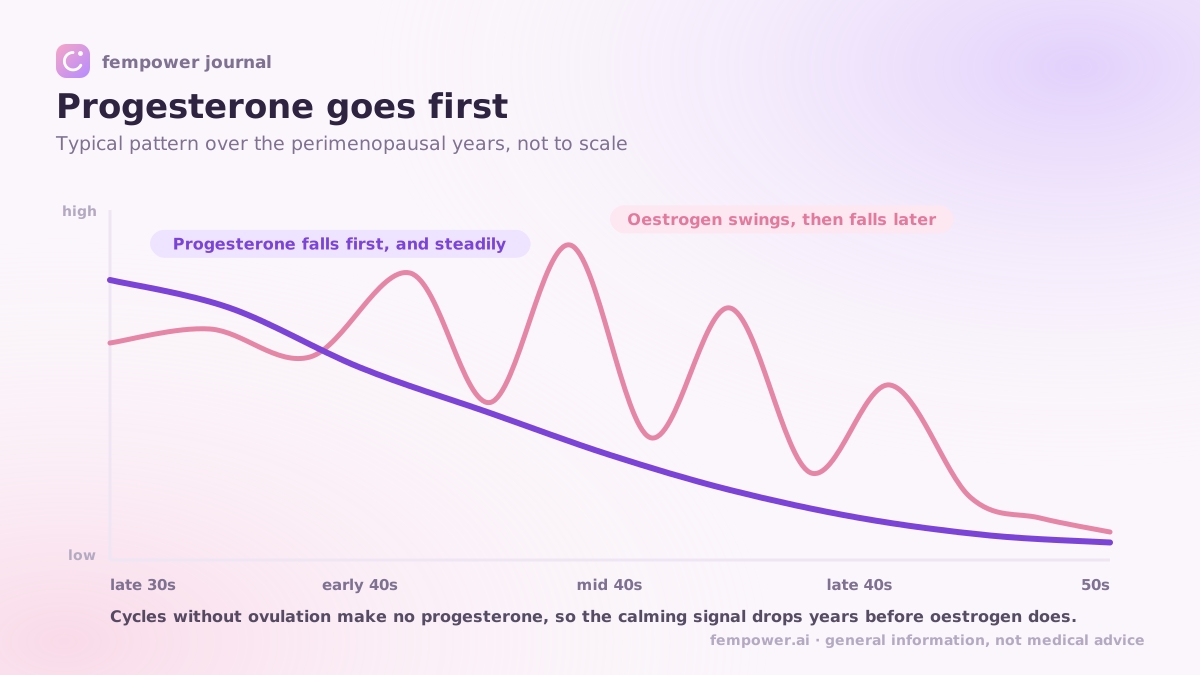
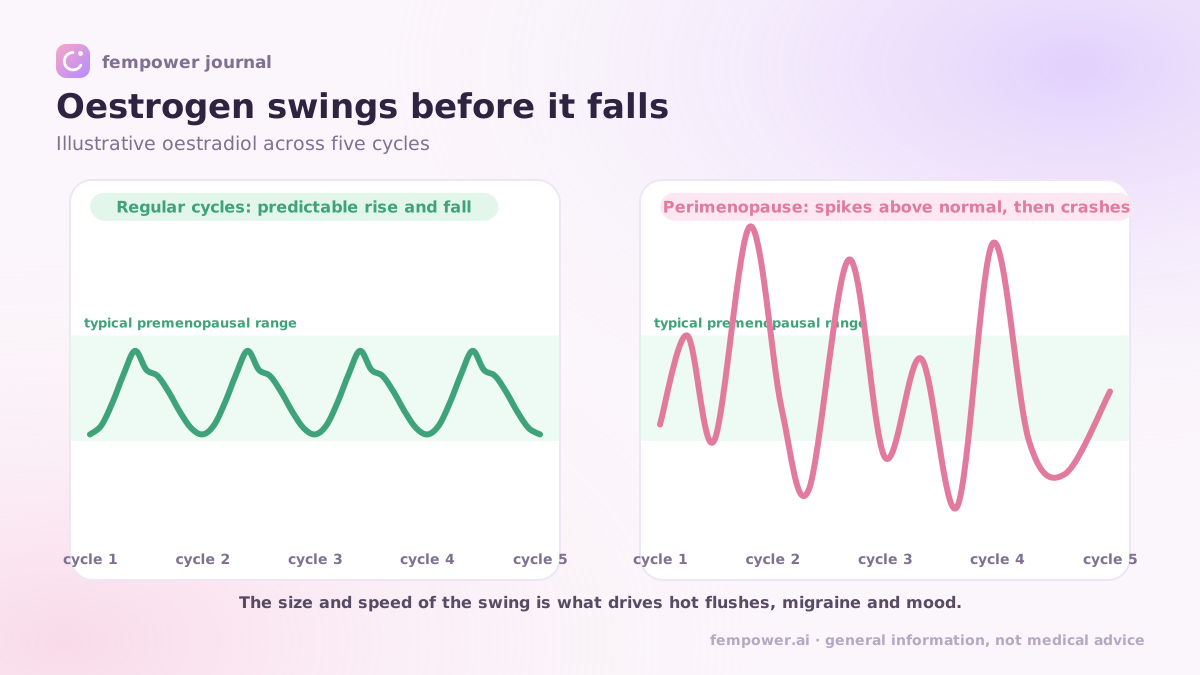
In perimenopause, ovulation becomes unreliable. The ovaries still produce oestrogen, and in some cycles more than usual, but in a cycle with no ovulation there is no corpus luteum, and so there is no progesterone. The lining keeps growing under unopposed oestrogen. It gets thick, fragile and disorganised. Eventually it outgrows its blood supply and breaks down in patches. The result is a bleed that is heavy, prolonged, clotty and arrives at an unpredictable time. Because progesterone is the first hormone to fall, this pattern can begin years before anyone would call you menopausal.
The SWAN study followed bleeding patterns in more than 1,300 women across the transition. Paramsothy and colleagues, publishing in BJOG in 2014, found that the majority reported at least one episode of heavy bleeding (three or more days of heavy flow) and most reported prolonged bleeding of ten days or more at some point. Heavy bleeding was the norm.
The cost in iron
Heavy periods lose iron faster than most diets replace it. Iron stores, measured as ferritin, can fall low long before a full blood count shows anaemia, and low ferritin alone causes fatigue, breathlessness on stairs, restless legs, hair shedding and poor concentration. Many women put these down to perimenopause itself, or to being busy, when a simple blood test would show an iron problem that is straightforward to treat. If your periods are heavy, ask for ferritin as well as haemoglobin.
Other causes worth knowing about
Anovulation explains most perimenopausal heavy bleeding. Other causes are common at this age too, and worth knowing.
- Fibroids. Non-cancerous growths in the womb muscle. Extremely common in the forties, often symptomless, but can cause heavy or prolonged bleeding and pressure symptoms.
- Endometrial polyps. Small growths of the lining. A frequent cause of bleeding between periods.
- Adenomyosis. Lining tissue within the womb wall. Heavy, painful periods and a tender, enlarged womb.
- Thyroid problems and clotting disorders. Less common but worth excluding.
- Endometrial hyperplasia. Thickening of the lining under prolonged unopposed oestrogen. Usually benign but needs assessing, because in some forms it can progress if left.
Treatments that work
This is a symptom with good options, and you do not have to put up with it until your periods stop.
- Levonorgestrel intrauterine system (the hormonal coil). Releases progestogen directly into the womb, keeps the lining thin, and reduces bleeding substantially for most women. NICE lists it as first-line for heavy menstrual bleeding. It also provides the progestogen part of HRT if you later start oestrogen.
- Tranexamic acid. A non-hormonal tablet taken only on heavy days that reduces blood loss by helping clots hold. Available from a GP.
- Cyclical or continuous progesterone. Micronised progesterone or a progestogen taken for part or all of the cycle replaces what the anovulatory cycle is missing and organises the shedding.
- Combined hormonal contraception. For women without contraindications, it regulates cycles and reduces flow.
- Iron. If ferritin is low, replacing it treats the fatigue regardless of what is done about the bleeding.
Heavy bleeding has a mechanism, a set of red flags and a range of effective treatments. Understanding the mechanism makes it easier to spot the red flags and ask for the treatment. Our FAQ covers what Fempower does and does not do around bleeding.
Questions people ask
- Why are my periods heavier in perimenopause?
- In cycles where ovulation does not happen, no progesterone is produced. Oestrogen keeps thickening the womb lining unchecked, and when it eventually sheds it does so heavily and unpredictably.
- Is heavy bleeding in perimenopause normal?
- It is very common. The SWAN study found most women experience at least one episode of heavy or prolonged bleeding during the transition. It should still be assessed if it is affecting you.
- When should I see a GP about heavy periods?
- If you bleed between periods or after sex, bleed after 12 months without a period, soak through protection hourly, pass large clots, have periods lasting over seven days, or have symptoms of anaemia.
- What is the best treatment for heavy perimenopausal periods?
- NICE recommends the levonorgestrel intrauterine system first-line. Tranexamic acid, cyclical progesterone and combined hormonal contraception are also options. Low iron should be treated separately.
- Can heavy periods cause tiredness and brain fog?
- Yes. Heavy bleeding depletes iron stores, and low ferritin causes fatigue, breathlessness and poor concentration even before anaemia develops. Ask your GP for a ferritin test.
References
- Bleeding patterns during the menopausal transition in the multi-ethnic Study of Women's Health Across the Nation (SWAN): a prospective cohort study. BJOG (Paramsothy P et al.), 2014.
- Heavy menstrual bleeding: assessment and management (NG88). NICE, 2021.
- Perimenopause: the complex endocrinology of the menopausal transition. Endocrine Reviews (Prior JC), 1998.
- Menopause: identification and management (NG23). NICE, 2024.