Brain fog in perimenopause: what the research shows
The word is on the tip of your tongue and then it is gone. Brain fog is one of the most alarming perimenopausal symptoms, and one of the best studied. The research is more reassuring than you might expect.
- Oestrogen
- Progesterone
- Cortisol
Key takeaways
- Brain fog in perimenopause is real, measurable and, for most women, temporary.
- The SWAN study found a dip in learning during late perimenopause that recovered after menopause.
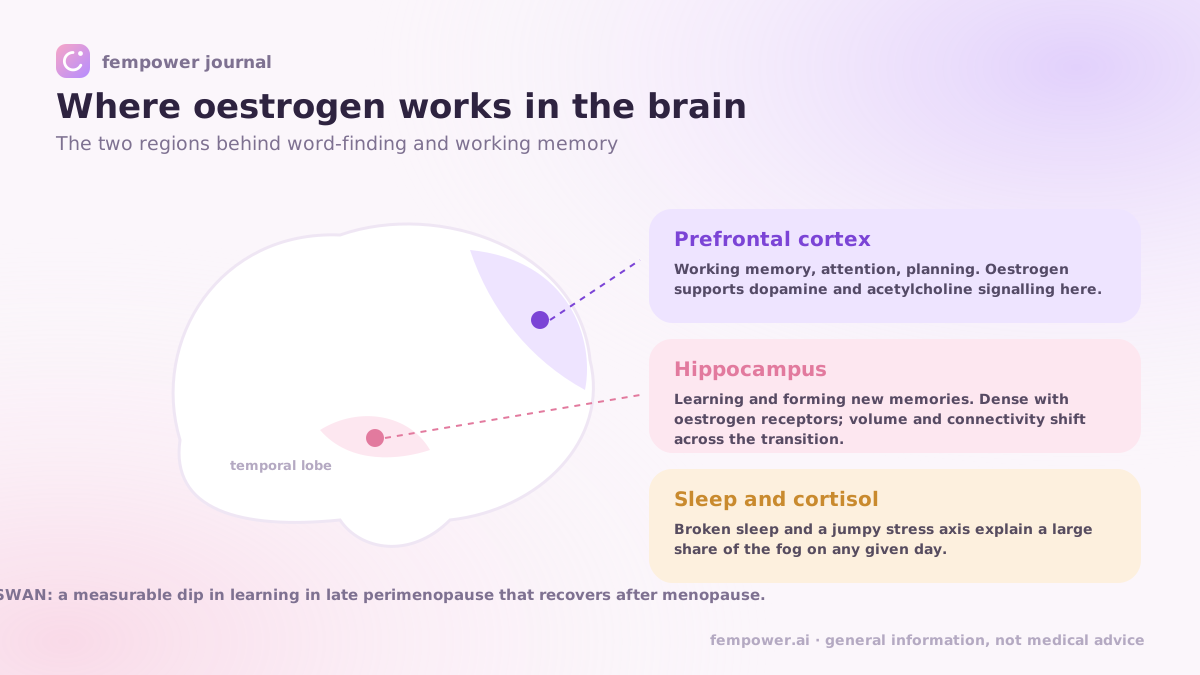
- Oestrogen supports the prefrontal cortex and hippocampus, the regions behind word-finding and working memory.
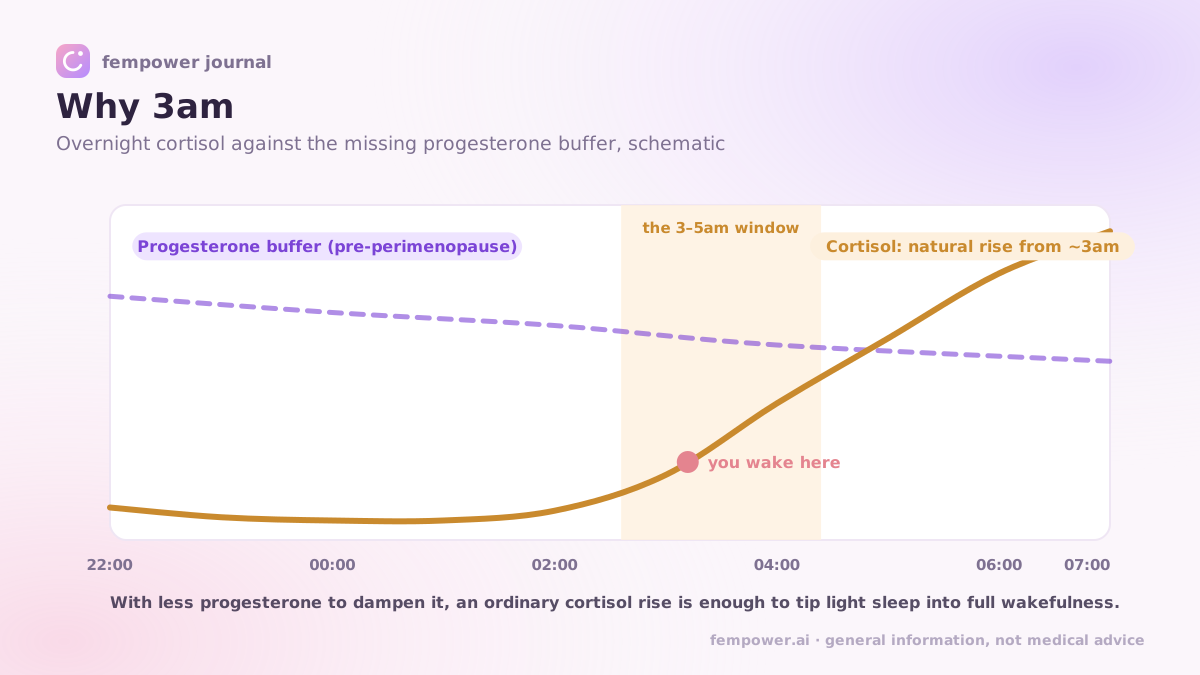
- Broken sleep is the biggest confounder. Fix the 3am waking and the fog often lifts.
- Thyroid, iron, B12 and depression can look identical and are worth ruling out with your GP.
You are mid-sentence in a meeting and the word is simply not there. You walk into a room and cannot remember why. You read the same paragraph three times. If you are in your forties and this has started happening, the first thought is often the frightening one. This pattern is common, well documented and, for the large majority of women, it eases with time.
What brain fog is
Brain fog is an everyday phrase, and the symptoms people describe under it are consistent: trouble finding words, losing the thread of a conversation, forgetting names and appointments, struggling to hold several things in mind at once, reading without absorbing. What these have in common is that they involve working memory (holding and manipulating information right now) and retrieval (getting something you already know out of storage). Long-term memory holds up fine. You still remember your childhood. It is the keys you put down thirty seconds ago that have gone.
What the SWAN study found
The Study of Women's Health Across the Nation (SWAN) has followed more than 3,000 women in the United States through the menopause transition since the mid-1990s. In 2009, Greendale and colleagues published cognitive testing from over 2,300 of those women, repeated year after year. Two findings matter here.
- During late perimenopause, women showed a measurable dip in verbal learning. They were not improving on repeated tests the way they had in earlier stages, which is the expected effect of practice.
- After menopause, that learning effect returned. The dip belonged to the transition itself, and it passed.
The size of the effect was modest, well short of anything that shows up on a clinical screen. But it was real, it matched what women had been reporting for decades, and it was tied to the stage of the transition more than to age.
Where oestrogen works in the brain
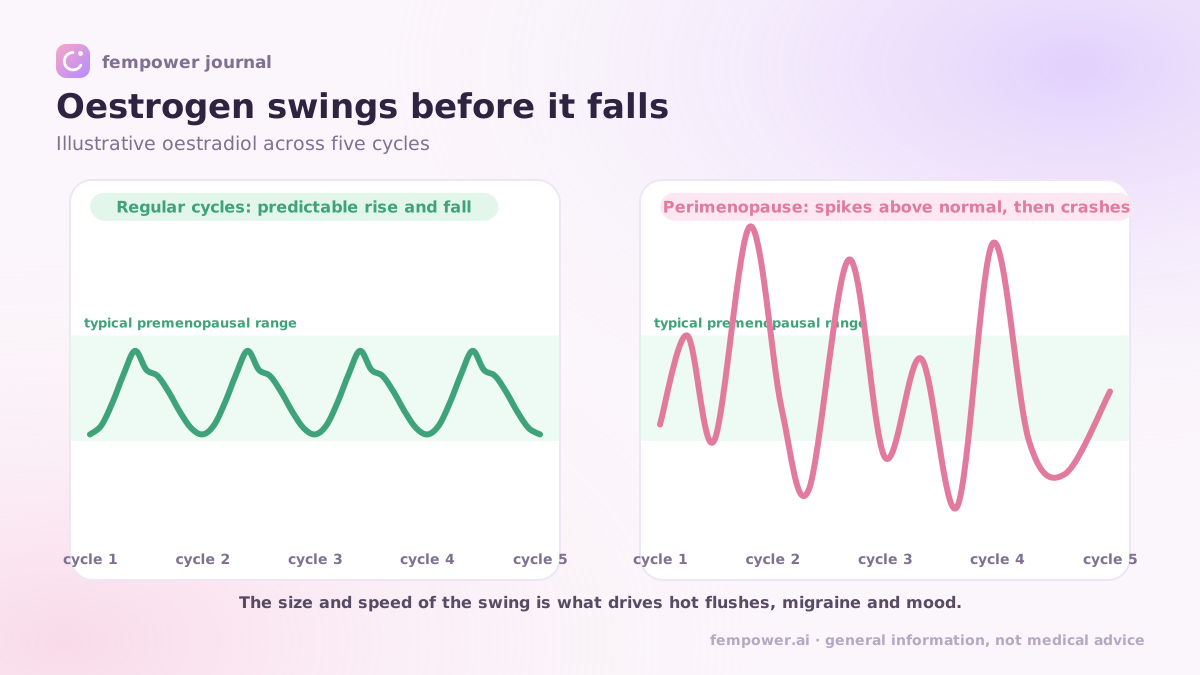
Oestrogen works well beyond the reproductive system. Receptors for it are found throughout the brain, and they are especially dense in two regions. The prefrontal cortex, just behind your forehead, handles attention, planning and working memory. The hippocampus, deep in the temporal lobe, is where new memories are formed and where spatial memory lives. Oestrogen supports blood flow, glucose use and the growth of connections between neurons in both areas. When the supply becomes erratic, as it does in perimenopause, these regions have to work with a less reliable input.
Lisa Mosconi's group at Weill Cornell used PET and MRI imaging to look at this directly. In a 2021 paper in Scientific Reports, they scanned women before, during and after the transition and found changes in grey matter volume, connectivity and glucose metabolism that tracked the menopausal stage more closely than age. Two details are reassuring. The changes were most pronounced in perimenopause and appeared to stabilise or partly recover afterwards, and the brain showed signs of adapting, with some regions increasing their activity to compensate. The transition looks like a period of reorganisation, with the brain adapting as it goes.
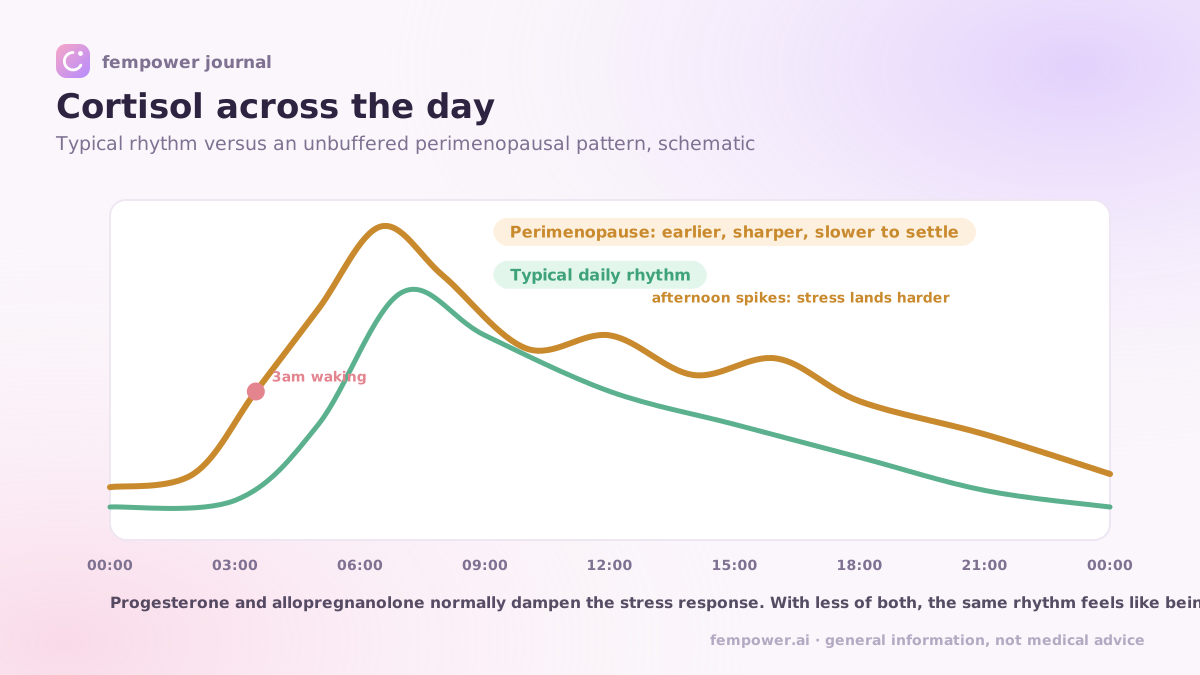
Oestrogen is only part of it. Progesterone also has receptors in the hippocampus, and it falls first. And when cortisol runs high, it directly impairs memory retrieval. Several drivers are usually acting at once.
The confounder nobody wants to hear about
Sleep. Most of the cognitive complaints of perimenopause are indistinguishable from the cognitive complaints of anyone who has slept badly for a month. Working memory, attention and word retrieval are exactly the functions that degrade first with poor sleep. If you are waking at 3am several nights a week, some proportion of your brain fog is sleep loss wearing a hormonal disguise. This part is often the most fixable. Women who get their sleep back frequently report that the fog thins considerably, even though nothing else has changed.
What else looks like this
Perimenopause is the likeliest explanation for new cognitive symptoms in a woman in her forties, and the other candidates are worth excluding because they are treatable.
- Underactive thyroid. Fatigue, low mood, weight gain and fog. A simple blood test.
- Iron deficiency. Common if your periods have become heavy. Low ferritin causes fog even before full anaemia.
- Vitamin B12 deficiency. More common in vegetarians, vegans and anyone on long-term acid-suppressing medication or metformin.
- Depression. Concentration and memory problems are core symptoms, and low mood in perimenopause is common. The two can coexist.
- Medication. Antihistamines, some sleep aids and some blood pressure medicines affect concentration.
What helps
- Treat sleep as the first job. Everything else is harder to judge while you are sleeping badly.
- Offload working memory. Lists, calendars and a single place for keys are what people with excellent memories do too.
- Move. Aerobic exercise is one of the best-evidenced supports for hippocampal function at any age.
- Consider HRT. NICE does not recommend HRT purely to improve cognition, but many women who take it for other symptoms report the fog lifting, partly because sleep and hot flushes improve. Discuss it with your GP.
- Be patient with yourself. The SWAN data says the dip is temporary. Most women come out the other side with their memory intact.
The evidence on this is clearer than it was ten years ago, and it points the same way. Brain fog in perimenopause is real, it has a mechanism, and it tends to pass. Read more about how the app maps symptoms to hormones on the science page.
Questions people ask
- Is perimenopausal brain fog a sign of early dementia?
- Almost never. The cognitive dip seen in perimenopause is modest, tied to the transition rather than age, and recovers after menopause in the large majority of women. Sudden onset, rapid worsening, or family history of early dementia are reasons to see a GP.
- Does brain fog go away after menopause?
- For most women, yes. The SWAN study found that the learning dip in late perimenopause returned to normal after menopause. Brain imaging research shows similar stabilisation.
- Which hormone causes brain fog?
- Low and erratic oestrogen is the main driver, because the prefrontal cortex and hippocampus depend on it. Falling progesterone and high cortisol also contribute, and broken sleep amplifies all of it.
- What blood tests should I ask for?
- Thyroid function, a full blood count, ferritin and vitamin B12. These rule out the common conditions that mimic perimenopausal brain fog.
- Does HRT help brain fog?
- NICE does not recommend HRT purely for cognitive symptoms, but many women taking it for other reasons report clearer thinking, often because sleep and hot flushes improve. It is worth discussing with your GP.
References
- Effects of the menopause transition and hormone use on cognitive performance in midlife women. Neurology (Greendale GA et al.), 2009.
- Menopause impacts human brain structure, connectivity, energy metabolism, and amyloid-beta deposition. Scientific Reports (Mosconi L et al.), 2021.
- Menopause: identification and management (NG23). NICE, 2024.
- Cognition and the menopause transition. British Menopause Society, 2023.