Why a blood test cannot diagnose perimenopause
"Your bloods are normal" is one of the most common and least helpful sentences in perimenopause. A single hormone reading can't settle the question. This explains why, and which tests are worth asking for.
- Oestrogen
- Progesterone
Key takeaways
- NICE guidance says perimenopause in women over 45 is diagnosed on symptoms alone, without blood tests.
- FSH and oestradiol swing from week to week in perimenopause, so one reading is a snapshot of a moving target.
- FSH has a role under 45, and especially under 40, where premature ovarian insufficiency needs ruling in or out.
- AMH can estimate how far away your final period is in research settings, but it is not a diagnostic test.
- The blood tests worth doing are the ones that rule out look-alikes: thyroid, iron, blood sugar, vitamin D and B12.
A woman in her mid forties goes to her GP. She is waking at 3am, her periods have gone strange, she cannot find words she has used all her life. A blood test is taken. The result comes back: normal. She is told it is probably stress. This scene plays out thousands of times a week, and it rests on a misunderstanding of what a hormone blood test can show.
What the guideline says
The NICE menopause guideline, NG23, is unusually direct. For women aged 45 and over, perimenopause should be diagnosed on symptoms: vasomotor symptoms such as hot flushes with irregular periods, or the wider pattern of perimenopausal symptoms, without any laboratory test. It specifically says not to use a follicle stimulating hormone (FSH) test to diagnose perimenopause or menopause in women over 45, nor in women of any age who are taking hormonal contraception or HRT, because those suppress the reading.
FSH does have a place. NICE says it can be considered in women aged 40 to 45 with symptoms, and it should be used in women under 40 where premature ovarian insufficiency is suspected, typically on two samples taken four to six weeks apart. What NICE does not recommend for diagnosis in any age group is oestradiol, anti-Müllerian hormone, inhibin, antral follicle count or ovarian volume.
Why one reading misleads
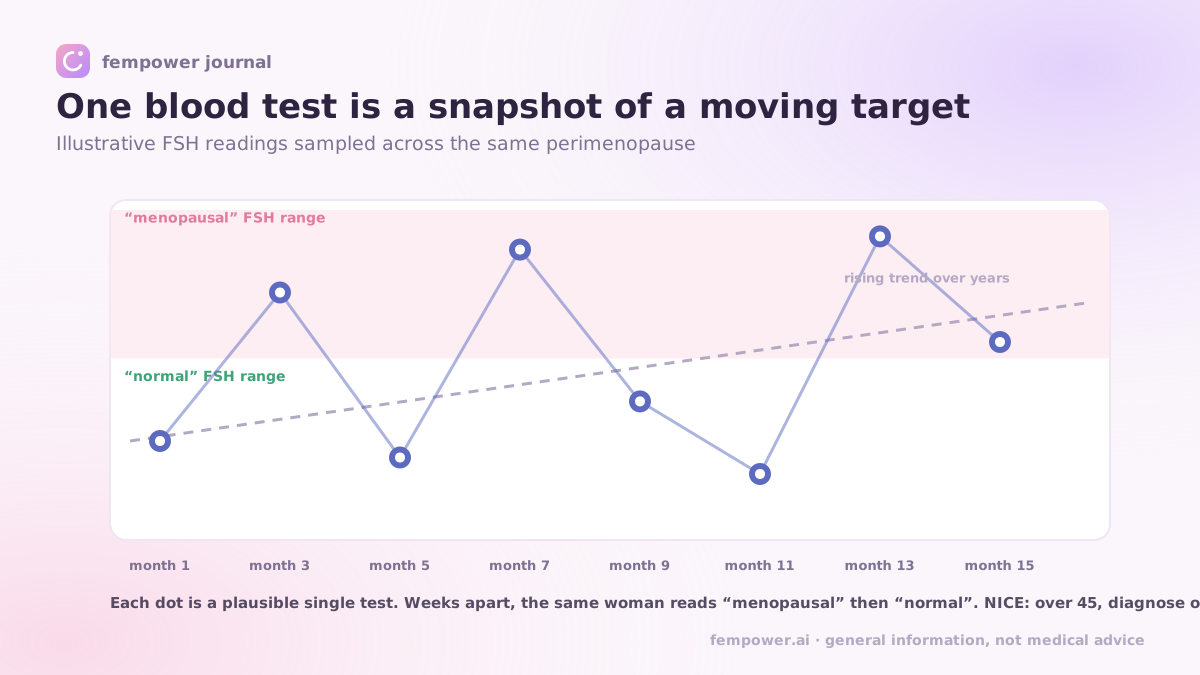
FSH is the signal from the pituitary gland asking the ovaries to produce a follicle. When the ovaries respond less readily, FSH rises to compensate. That is why a high FSH is associated with menopause. The problem in perimenopause is that the ovaries respond sometimes. One month a follicle develops normally, oestrogen rises, FSH falls back into the normal range. The next month nothing much happens, oestrogen stays low, FSH climbs. A single blood draw catches one of those moments, at random.
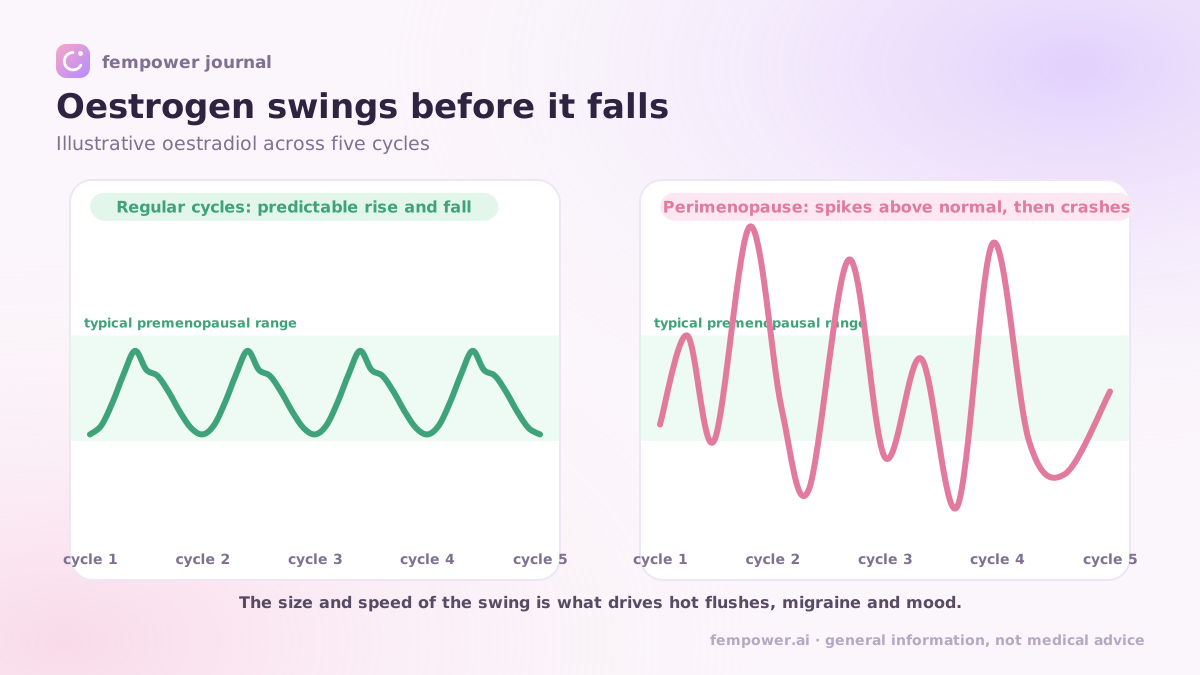
Oestradiol is worse. In perimenopause it swings, sometimes higher than it ever was in your twenties. A reading taken on a high week looks like nothing is wrong. A reading taken three days later might look menopausal. Neither reading is wrong, and neither tells you anything on its own.
This is the point the diagram makes. Each dot is a real-looking measurement. The dotted line is the trend nobody can see from any one dot.
What about AMH?
Anti-Müllerian hormone is made by the small follicles left in the ovary, so it falls as the reserve runs down and does not bounce around the cycle the way FSH does. That makes it a more stable marker, and researchers have used it to estimate how far a woman is from her final period. Analysis from the SWAN study, published in 2020, found that once AMH drops below the detectable threshold, the final period is likely within a few years for most women.
Estimating the distance to your last period is a different question from explaining your symptoms now. Two women with the same AMH can feel completely different. NICE does not recommend it for diagnosis, and a low AMH does not tell you which hormone is behind your 3am waking. Its home is in research and fertility clinics.
The private hormone panel trap
The frustration of being told your bloods are normal drives many women to private clinics offering a full hormone panel. What comes back is a page of numbers with reference ranges, some flagged red. It feels like evidence. In perimenopause it is mostly noise, for exactly the reason above: the values were always going to be somewhere on the swing, and the swing is the condition.
Where a panel does help is in tracking treatment, for example checking oestradiol absorption on a patch or gel, or making sure testosterone stays in the female range. That is monitoring treatment that has already started. The diagnosis itself comes from your symptoms and their timing.
Tests that are worth doing
None of this means blood tests are pointless. Several conditions look like perimenopause and are easy to check for:
- Thyroid function (TSH, free T4): an underactive or overactive thyroid causes fatigue, weight change, mood change, palpitations and irregular periods.
- Ferritin and full blood count: heavy perimenopausal periods can drain iron stores, and low iron causes exhaustion, breathlessness, palpitations and hair loss.
- HbA1c: insulin resistance and early diabetes overlap with weight gain, tiredness and night waking.
- Vitamin D and B12: low levels contribute to aching, low mood and fatigue, and are easy to correct.
Symptoms diagnose perimenopause. Blood tests rule out what else could be going on.
Questions people ask
- Can a blood test confirm perimenopause?
- Not reliably. NICE guidance says women over 45 should be diagnosed on symptoms alone, because FSH and oestradiol fluctuate so much in perimenopause that a single reading can look normal or menopausal on different days.
- When is an FSH test useful?
- NICE says FSH can be considered in women aged 40 to 45 with symptoms, and should be used in women under 40 where premature ovarian insufficiency is suspected. It should not be used in women on hormonal contraception or HRT.
- Does AMH diagnose perimenopause?
- No. AMH reflects ovarian reserve and can estimate roughly how far away the final period is in research settings, but NICE does not recommend it for diagnosing perimenopause and it does not explain individual symptoms.
- Which blood tests should I ask for?
- The ones that rule out conditions that mimic perimenopause: thyroid function, ferritin and a full blood count, HbA1c, vitamin D and B12.
References
- Menopause: identification and management (NG23). NICE, 2024.
- Antimüllerian Hormone and Impending Menopause in Late Reproductive Age: The Study of Women's Health Across the Nation. Journal of Clinical Endocrinology & Metabolism (Finkelstein JS et al.), 2020.
- Executive summary of the Stages of Reproductive Aging Workshop + 10. Menopause (Harlow SD et al.), 2012.
- Diagnosing menopause and perimenopause. British Menopause Society, 2023.