The luteal phase: why the week before your period is the worst
If your worst week keeps arriving just before your period, you are watching the late luteal phase at work, and in perimenopause it gets louder. Why that happens, and what to do with the pattern.
- Progesterone
- Oestrogen
Key takeaways
- The luteal phase is the second half of the cycle, from ovulation to the period. Progesterone rises then falls, and oestrogen falls with it in the last few days.
- In perimenopause the luteal phase is often short or makes little progesterone, so the calming half of the cycle is weaker and the withdrawal is sharper.
- Sleep, anxiety, migraine, bloating and breast tenderness cluster in the late luteal window because of that double withdrawal.
- PMS, PMDD and perimenopausal amplification overlap. The distinguishing feature of PMDD is severity, and it has its own referral route.
- Log symptom timing against your cycle for two or three months and "random" usually becomes a pattern you can plan around.
There is a version of you that turns up for about five days a month. Sleep breaks. Everything is irritating. A migraine looms. Your jeans do not fit. Then a period arrives and, within a day or two, you are back. If that sounds familiar, you already know the luteal phase. This post explains what is happening in it and why perimenopause makes it worse.
The two halves of a cycle
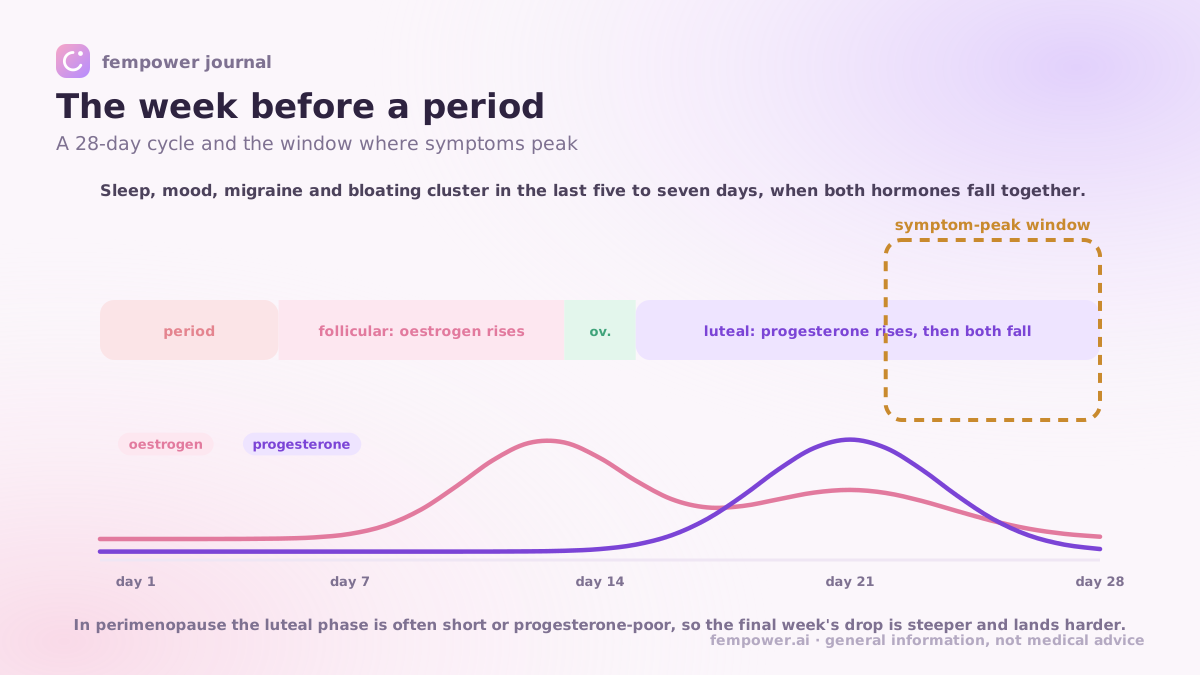
Day one is the first day of a period. The follicular phase runs from then to ovulation. Oestrogen rises steadily as a follicle matures, peaking just before the egg is released. Most women feel best in the second half of this phase.
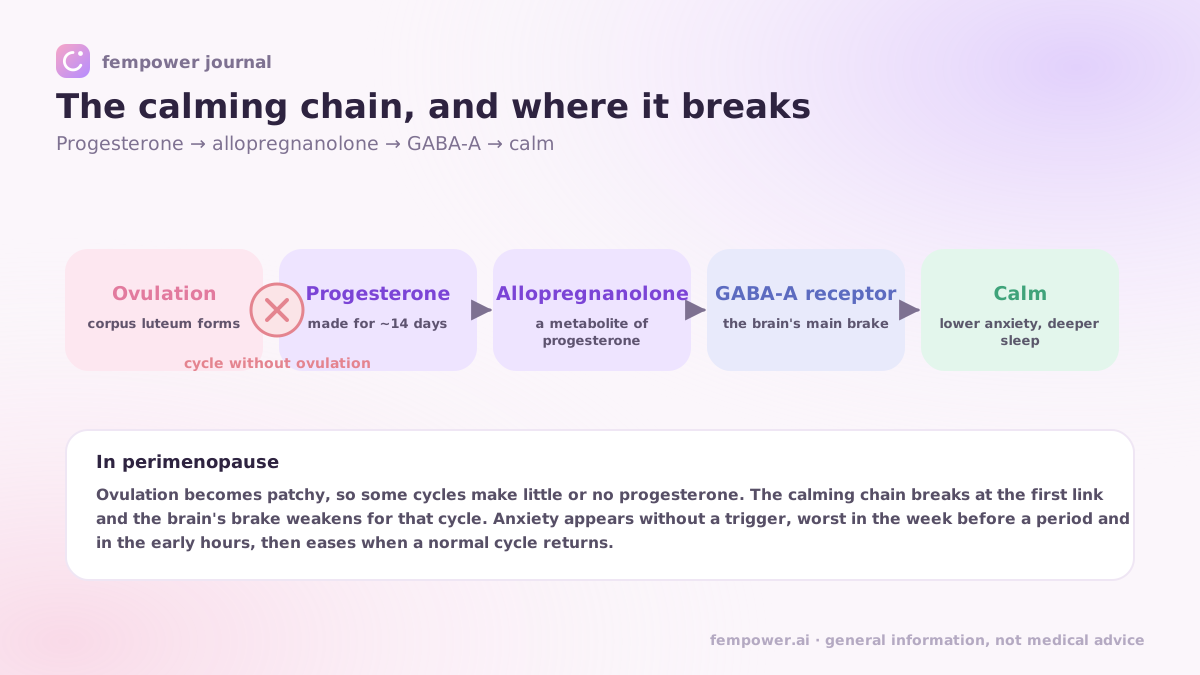
Ovulation happens around the middle of the cycle. The empty follicle becomes the corpus luteum, and the corpus luteum makes progesterone. That is the only significant source of progesterone in a cycle. Without ovulation there is no corpus luteum, and so no progesterone.
The luteal phase runs from ovulation to the next period, usually twelve to fourteen days. Progesterone climbs for about a week, oestrogen has a smaller second rise, and then, if there is no pregnancy, the corpus luteum gives up. Both hormones fall over the last four or five days. The lining sheds and the cycle starts again.
Why the last week is the hard one
Progesterone is calming. It works on the GABA system, the same one that sleeping tablets act on, through a metabolite called allopregnanolone. For most of the luteal phase you have more of it than at any other time. Then it is withdrawn, fast, at the same moment oestrogen is falling. The brain notices.
- Sleep fragments. The calming signal has dropped and cortisol's early-morning rise has nothing to buffer it, so 3am waking clusters here.
- Mood turns. Anxiety, irritability and low mood are the classic late-luteal symptoms because both hormones affect serotonin and GABA signalling.
- Migraine. The oestrogen drop is a well-known migraine trigger. Menstrual migraine is defined by attacks in the window from two days before to three days into a period.
- Bloating and breast tenderness. Progesterone and oestrogen both affect fluid handling and breast tissue.
What perimenopause changes
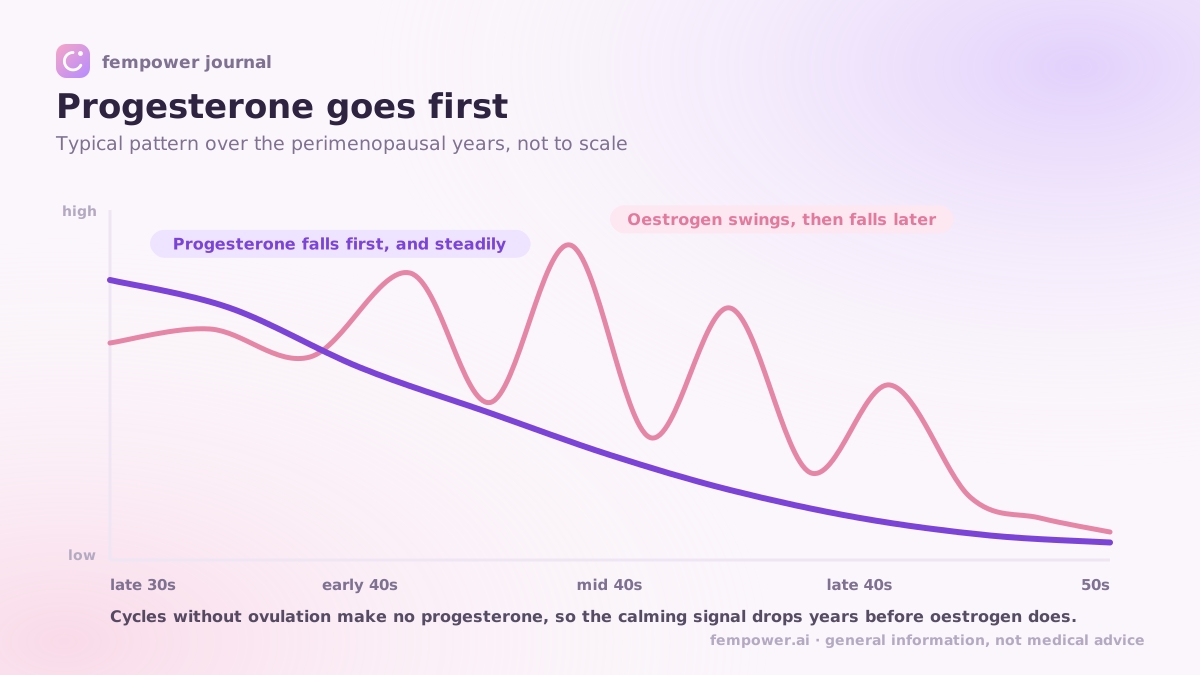
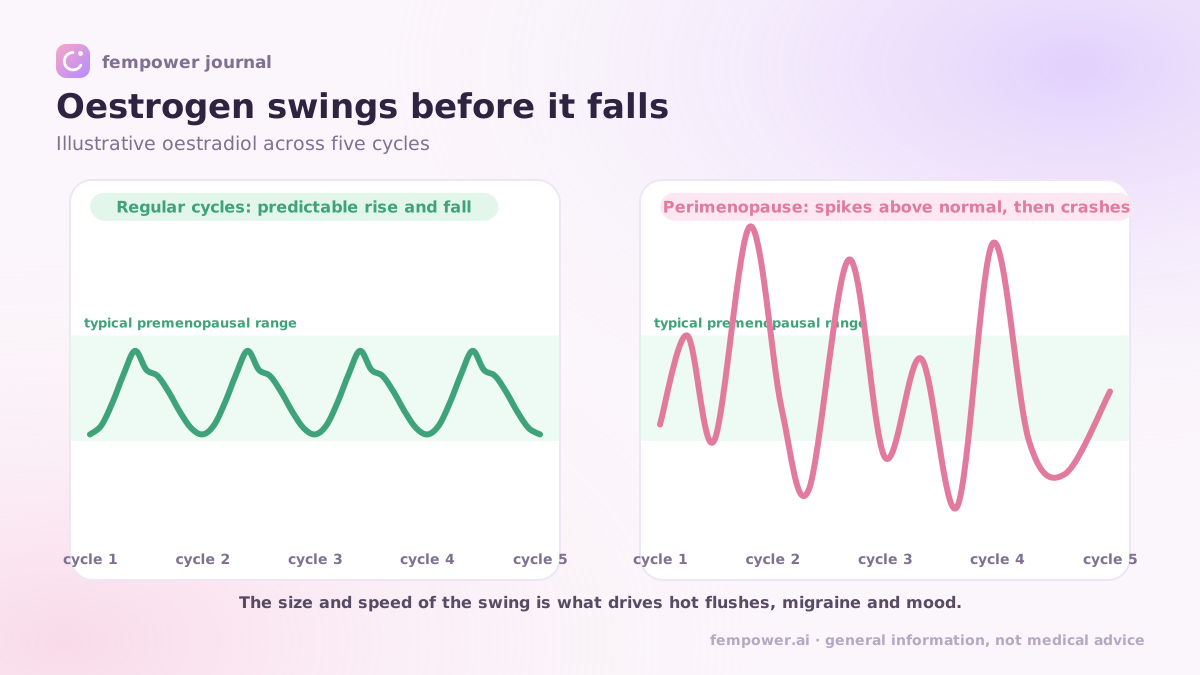
In your twenties and thirties most cycles ovulate properly and the corpus luteum does its job. From the late thirties onwards that becomes less reliable. Some cycles do not ovulate at all, so there is no luteal phase and no progesterone, just oestrogen swinging without anything to balance it. Others ovulate but produce a weak, short luteal phase with less progesterone than before.
Either way, two things happen. The calming half of the cycle is weaker, so the whole cycle feels more anxious and less slept. And when progesterone is withdrawn, the drop is often against a background of erratic, sometimes very high oestrogen, so the contrast is sharper. Women who never had PMS start getting it. Women who had mild PMS find it is now a week they have to plan around. That is progesterone being the first hormone to fall, seen from inside one cycle.
PMS, PMDD, or perimenopause?
These overlap and the labels matter mainly for what to do next.
- PMS is physical and emotional symptoms in the luteal phase that resolve with the period. Very common. Managed with lifestyle, cycle-aware planning, and sometimes hormonal or SSRI treatment.
- PMDD (premenstrual dysphoric disorder) is a severe form: mood symptoms bad enough to seriously affect work, relationships or safety, in most cycles. It is thought to be an unusual sensitivity to normal hormone changes; the levels themselves are usually normal. It has specific treatment routes, including SSRIs taken only in the luteal phase, and specialist referral.
- Perimenopausal amplification is ordinary PMS getting worse in your forties because the luteal phase is now unreliable. Often responds to stabilising the hormones, which is where HRT, and in particular the timing and type of progesterone, comes in.
The Royal College of Obstetricians and Gynaecologists has a guideline on premenstrual syndrome that covers this whole spectrum. If your luteal week includes thoughts of harming yourself, that is PMDD territory and it deserves a direct conversation with a GP, well beyond anything an app can offer.
Turning random into a pattern
The single most useful thing you can do is date your symptoms against your cycle for two or three months. You only need the bad days, with the cycle day noted. What tends to emerge is that a symptom you thought was random arrives on roughly the same day each cycle. Once you can see that, you can do something with it.
- Predict the week. Knowing it is coming takes a lot of the fear out of it.
- Protect sleep in the run-up: earlier nights, no alcohol from about day 22, a cooler room.
- Do not schedule the difficult conversation, the long drive, or the medical appointment for day 26 if you can avoid it.
- Take the pattern to your GP. "My anxiety and sleep collapse in the five days before every period" is a sentence a clinician can act on.
Questions people ask
- What is the luteal phase?
- The second half of the menstrual cycle, from ovulation to the next period, usually twelve to fourteen days. The corpus luteum makes progesterone during it, and both progesterone and oestrogen fall in its final days.
- Why do I feel worse the week before my period?
- Progesterone and oestrogen both fall in the last few days of the luteal phase. Progesterone is calming through the GABA system, so its withdrawal affects sleep and mood, and the oestrogen drop can trigger migraine and low mood.
- Does PMS get worse in perimenopause?
- Often, yes. In perimenopause some cycles do not ovulate or produce little progesterone, so the calming half of the cycle is weaker and the withdrawal is sharper against erratic oestrogen. Women who never had PMS can develop it.
- How is PMDD different from PMS?
- PMDD is a severe form in which luteal-phase mood symptoms seriously affect daily life or safety in most cycles. It has its own treatments, including luteal-phase SSRIs, and warrants specialist referral.
References
- Management of Premenstrual Syndrome (Green-top Guideline No. 48). Royal College of Obstetricians and Gynaecologists, 2016.
- Menopause: identification and management (NG23). NICE, 2024.
- Executive summary of the Stages of Reproductive Aging Workshop + 10: addressing the unfinished agenda of staging reproductive aging. Menopause (Harlow SD, Gass M, Hall JE, et al.), 2012.
- Perimenopause: the ovary's frustrating grand finale. Endocrine Reviews (Prior JC), 1998.